

Why the Best VR Headset Isn’t Always the Most Expensive!
Why Your PC Spec’s Determine the BEST Choice in VR Headset!
“The best VR headset isn’t necessarily the one with the highest resolution. It’s the one that delivers the best experience on the PC you already own.”


Welcome.
If your a VR user or considering leaping into the incredible wold of virtual reality these series of blog posts take you from:
- Beyond the Specs! A Flight Simmer’s Guide to Virtual Reality & Pimax VR.
- Beyond the Specs. The Optics Behind VR.
- Beyond the Specs – QLED vs Mini-LED vs Micro-OLED for Flight Simulation VR.
- Beyond the Specs – The Ultimate Pimax VR Buyer’s Guide (2026).
- Beyond the Specs – The Software Technology making VR Incredible! *******
- Beyond the Specs – Tracking Systems Explained – (Upcoming)
If you’ve spent any time researching virtual reality for flight simulation, you’ve probably experienced the same thing I experienced. Every review seems to begin with a list of specifications then followed by:
Resolution – Field of View – Refresh Rate – Pixels Per Degree – Lens Type – Display Type.
Then inevitably, somewhere near the end of the review comes the inevitable recommendation: “If you want the best experience, buy the flagship model.“

At first glance, that advice seems perfectly reasonable. After all, who wouldn’t want the highest resolution, the widest field of view, and the newest display technology? I certainly would!
But after eight plus years of flying in virtual reality and owning an Oculus Rift S, Meta Quest 3S, I have woken up to realise that this approach misses the most important question entirely.!
Can your PC Actually Drive it?
Experiencing flight simulation at its absolute best you must ask another entirely more important question! This question overrides every other consideration you may have had up to now!
There is no point having the most incredible expensive high quality virtual reality headset like the amazing PIMAX CRYSTAL SUPER if you have an average PC build at home that cannot run it!
Pimax Range Snapshot!
You wouldn’t expect to enjoy a beautiful 4K Wide Screen OLED Gaming experience on a Ryzen 5600X & Nvidia RTX 3070 would you? No, of course you wouldn’t! Would you expect to run TWO 4K displays on the system? You may try, but it will fail and we all know this is true in our little fast beating PC building hearts!
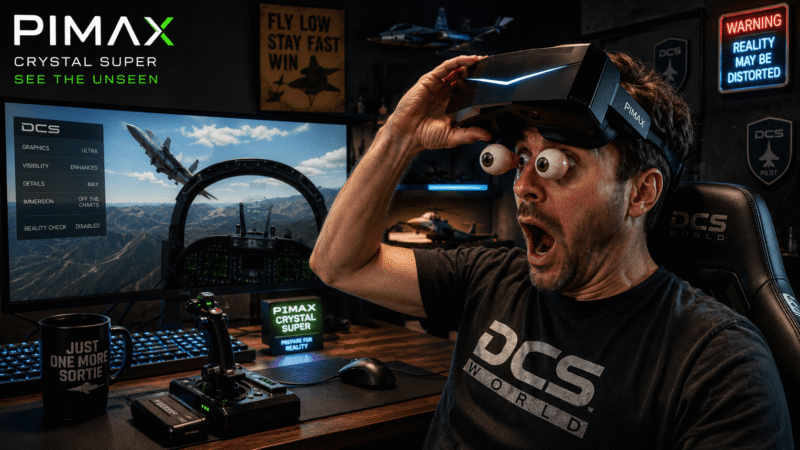
It just simply cannot do it! So why would you expect the PIMAX CRYSTAL SUPER to be any different? Note: A standard 4K monitor resolution is 3840 × 2160 pixels. Lets compare the PC graphics workload with these two incredible VR headsets!
The Pimax Crystal Super base resolution is 3840×3840 per eye! This is 77.8% more pixels than a 4k TV Per EYE! So you running more than 4k Plus resolution per eye! Now double this workload over two displays and that’s a huge ask from an average system!
Are we getting the message yet my flight simulator VR flying friends! The demands are monstrous!
Pimax recommendations are: Minimum spec: RTX 2080 – Recommended: RTX 3070 and higher!
So, 3840 × 3840 has about 78% more pixels than a standard 4K monitor!
If we consider the Pimax Crystal light its display resolutions is 2880 × 2880 pixels per eye! This still equates to a full 4K monitor per eye! That’s incredible fidelity right there but what a workload for your PC! Could your system run it?
Pimax recommendations are: Minimum spec: RTX 2080 – Recommended: RTX 3070 and higher!
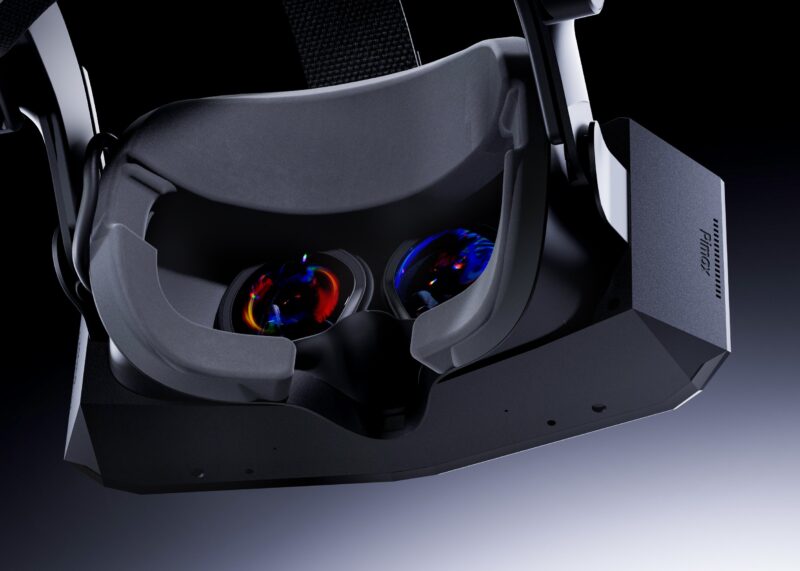
Flight Simulator Demands.
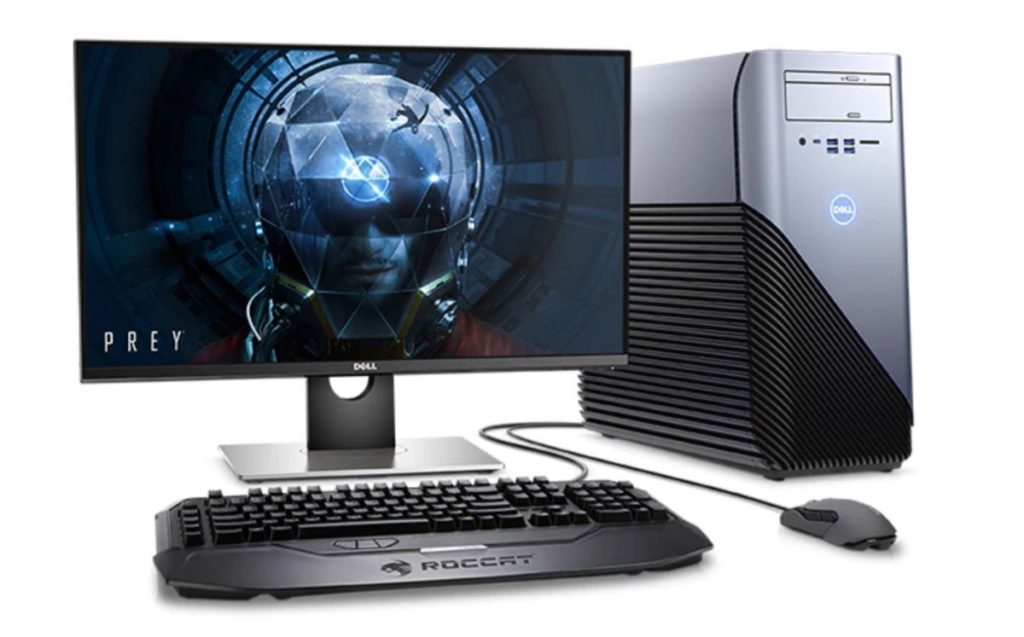
Flight simulators push today’s hardware to its limits long before you introduce a modern VR headset. Adding virtual reality doesn’t simply increase the graphical load, it fundamentally changes how much work your computer has to perform every single frame.
Rather than chasing the most expensive headset available, my goal is to help fellow sim pilots understand why they should choose the headset that delivers the best overall experience for their system.
Sometimes, those two things are exactly the same. But, very often, they aren’t.
I’m a Passionate VR Simmer!

Like many flight simulation enthusiasts, my time is divided mainly between X-Plane 12 and DCS World, with the occasional flight in Microsoft Flight Simulator.
Each simulator presents its own unique challenges.
X-Plane is renowned for its exceptional flight dynamics and increasingly realistic lighting engine. It has leaped forward in recent times with specific VR optimisations bringing amazing results!
DCS World delivers some of the most immersive military aviation experiences available anywhere, while simultaneously pushing modern CPUs and GPUs incredibly hard especially in multiplayer where even RAM becomes an important commodity.
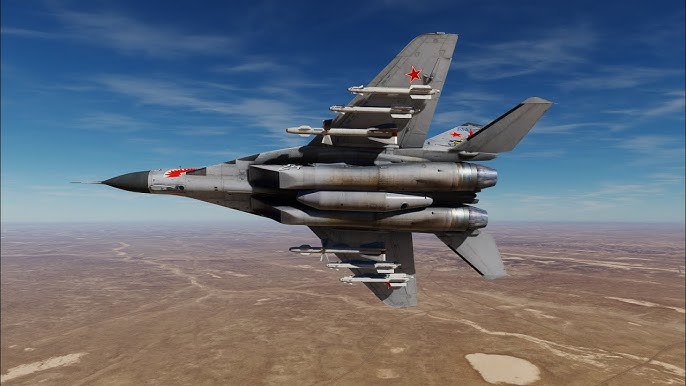
Microsoft Flight Simulator remains visually stunning, but it also has its own unique performance demands. The depth of experiences has widened since MSFS 2020 to a wider realm with all types of GA and commercial aircraft now augmented with a number of military options.
The common thread between all three is simple:
They are among the most demanding PC games ever created!
That reality changes the conversation around VR.
A headset that performs brilliantly in racing games or first-person shooters may become a very different experience when rendering detailed cockpits, vast terrain, weather systems, AI traffic, multiplayer aircraft and complex avionics simultaneously.
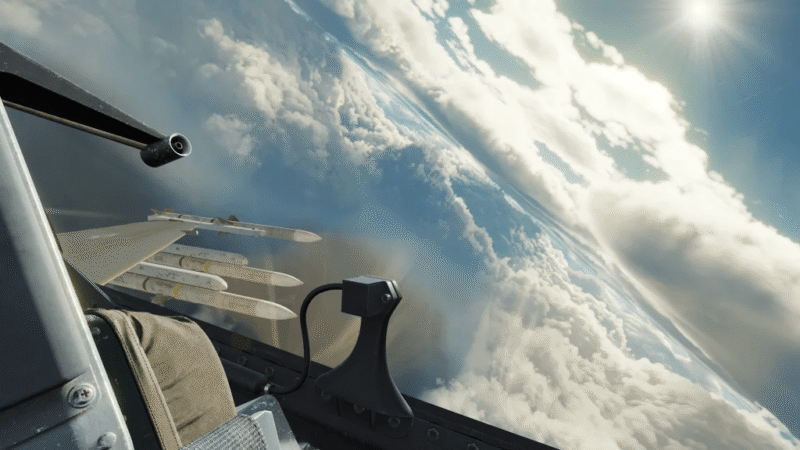
As sim pilots, we aren’t chasing 240 frames per second. Often 30 in virtual reality is a dream number in X Plane 12 with many PC pilots average PC systems able to push DCS World further. We pray the ASW makes the difference and smoothens the experience out but its not always the case!
We’re chasing something far more valuable.
Smoothness – Comfort – Readability – Situational awareness – Immersion.
Those qualities aren’t determined solely by resolution. They’re determined by balance.
The Biggest Mistake VR Buyers Make!
When researching VR headsets, most buyers naturally compare the specifications. It’s exactly what manufacturers expect us to do!
One headset offers a higher resolution, another promises a wider field of view, we continue to a third introduces eye tracking, and it goes on with someone else advertises Micro OLED displays! Where does it finish?
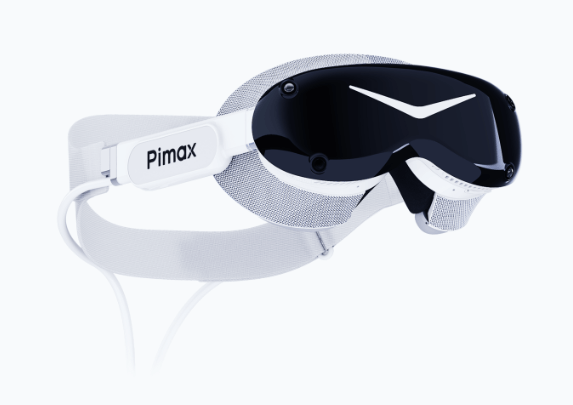
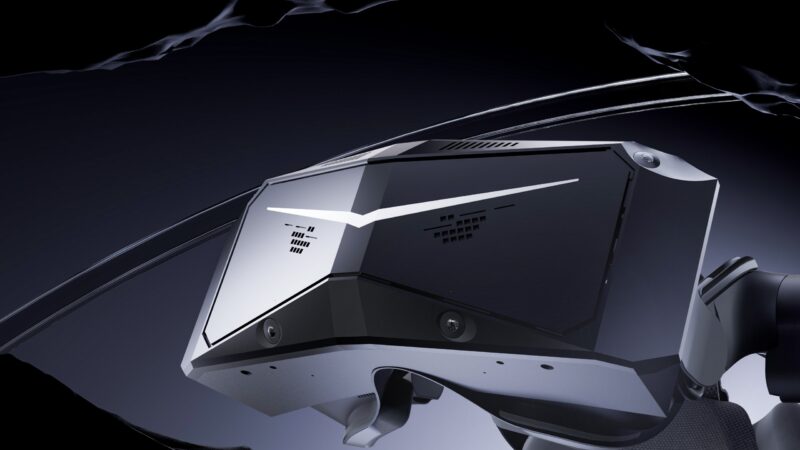
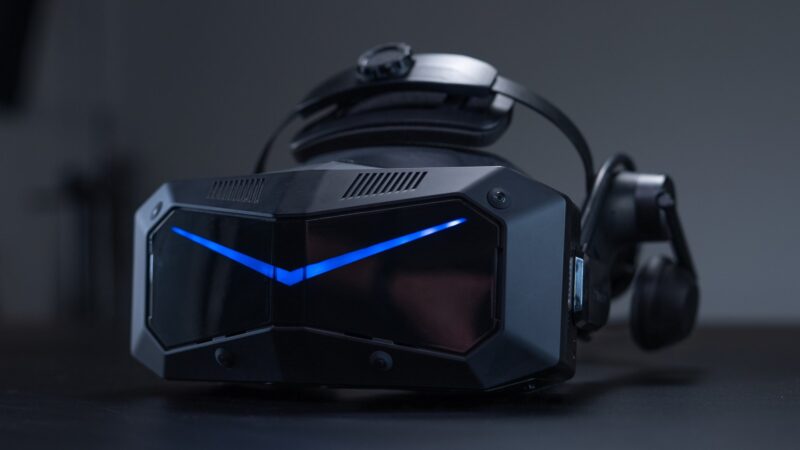
Experience flight simulation the way it was meant to be. Whether you choose the incredible value of the Pimax Crystal Light, the uncompromising visual performance of the Crystal Super, or the ultra-lightweight Dream Air, you’ll enjoy breathtaking clarity, wider fields of view, and cockpit detail like never before.
Click below to find the perfect Pimax headset for your simulator and save with our exclusive affiliate discounts.
Experience Flight Simulation Like Never Before
Choose Your Pimax Crystal Light, Crystal Super or Dream Air Today and Enjoy an Exclusive 2% LetsFlyVFR Discount*
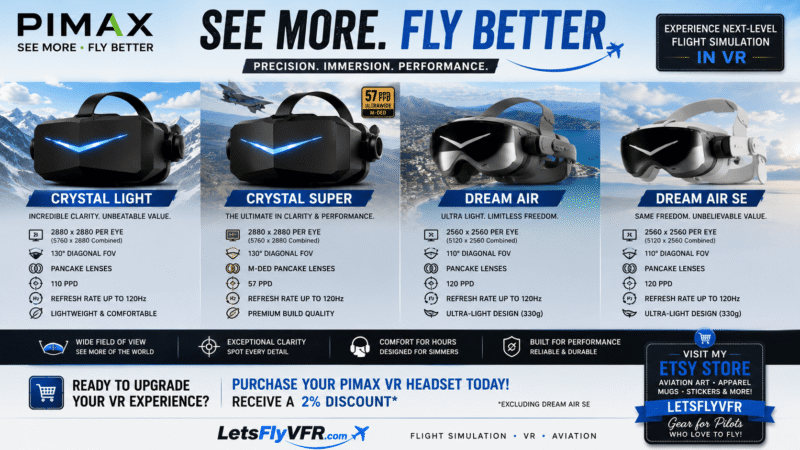
*Discount applies to eligible Pimax headsets. Dream Air SE excluded.
Before long, the conversation becomes an endless race of bigger numbers. Unfortunately, those numbers rarely tell the whole story. Imagine buying a Formula One car to drive through city traffic. It might genuinely be the fastest machine ever built. But if it can’t operate comfortably in the environment where you’ll actually use it, it’s the wrong vehicle!
Virtual Reality is Remarkably Similar!
A headset designed around cutting-edge hardware isn’t automatically the best choice for every simmer. In many cases, it can actually produce a worse experience than a more balanced headset because your graphics card spends its entire time struggling to maintain acceptable frame rates.
The result?
More stuttering – More reprojection – Higher latency
Reduced visual settings – Less immersion.
Ironically, spending more money on a VR headset can sometimes produce a poorer experience. That’s a difficult concept for marketing departments to embrace, but it’s an important one for consumers.
YOUR NEXT FAVOURITE FLIGHT SIM GEAR IS WAITING!
Discover Premium Aviation Artwork, Apparel & Pilot Gifts at the LetsFlyVFR Etsy Store.



⭐⭐⭐⭐⭐ Trusted by Flight Simulation Enthusiasts Worldwide
Flight Simulation Isn’t Like Other Games!
In-depth Breakdown for new PC Flight Simmers!
One of the biggest misconceptions surrounding VR is the belief that all games place similar demands on your hardware.
Nothing could be further from the truth. A typical first-person shooter loads relatively compact environments. Players move quickly through confined areas. Objects appear for only short periods before disappearing behind walls or terrain. Flight simulators operate at an entirely different scale.
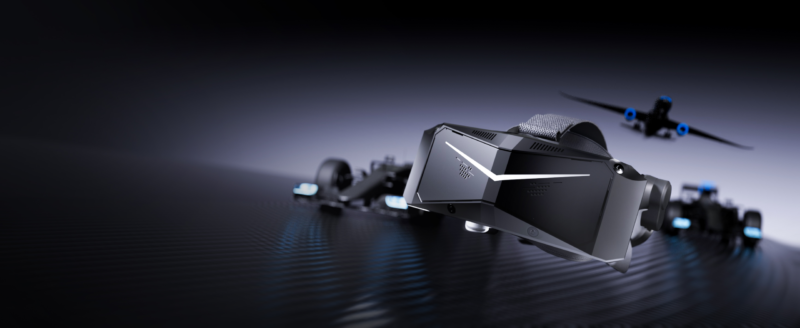
Instead of rendering a single room, your PC may be displaying hundreds of square kilometres of terrain.
Cities – Forests – Airfields – Road traffic – Weather systems – Cloud layers – Dynamic lighting – Cockpit instrumentation – Artificial intelligence – Multiplayer aircraft – Ground vehicles – Missiles – Particle effects – Radar systems – Navigation databases.
Every one of these systems competes for precious CPU and GPU resources and its being done ALL AT ONCE! Then virtual reality effectively asks your computer to render the scene twice and separate views for each eye!

Remember my friends these are not one image copied because of the need for angle change to create the 3D depth we love are two totally separate images. All done while attempting to maintaining extremely low latency to avoid motion sickness.
That’s a monumental workload. Its unprecedented in the world of PC Master race gaming! It’s one reason why flight simulation has become one of the ultimate tests of modern PC hardware.
Clarity Matters More Than Raw Frame Rate!
Ask ten competitive gamers what matters most and you’ll probably hear one answer repeated over and over. Frames per second (FPS) but flight sim pilots think differently & of course smooth performance is essential.
It’s also equally important that you can actually see in the cockpit clearly, read a radio frequency without leaning forward, you identify another aircraft ten nautical miles away?
Can you glance down at your engine instruments while remaining on final approach? Can you scan an entire instrument panel simply by moving your eyes instead of constantly moving your head? These are the small details that transform virtual reality from an impressive demonstration into an authentic cockpit experience.
Lens quality – Display quality – Contrast – Edge-to-edge clarity – Sweet spot size.
These factors often become just as important as raw pixel count.
It’s another reason why comparing headsets purely by resolution can be misleading.
The Reality of Today’s Gaming PCs.
One topic almost every headset review overlooks is this simple question:
What hardware do most people actually own?
Spend enough time watching YouTube reviews and you’d be forgiven for thinking every simmer owns an RTX 5090 paired with the latest flagship processor.
The reality is very different.
Most PC gamers build their systems gradually over many years. They upgrade a graphics card when finances allow. Perhaps add more memory the its maybe replace the CPU after several generations. Very few enthusiasts replace an entire computer every product cycle.
I’m absolutely no different having just upgraded from the RTX 3070 after a few years to get an RTX 5070 but my poor Ryzen 5600x seems now to be just on the borderline of doing its job.
At the time of writing, my own system consists of:
- NVIDIA RTX 5070
- AMD Ryzen 5 5600X
- 64 GB DDR4 memory
It’s a capable gaming PC. But it isn’t a limitless one. And that’s exactly why I think it represents a much larger audience than many benchmark systems featured online.
The Steam Hardware Survey Tells an Interesting Story.
One of the best ways to understand the gaming community is by looking at the monthly Steam Hardware Survey.
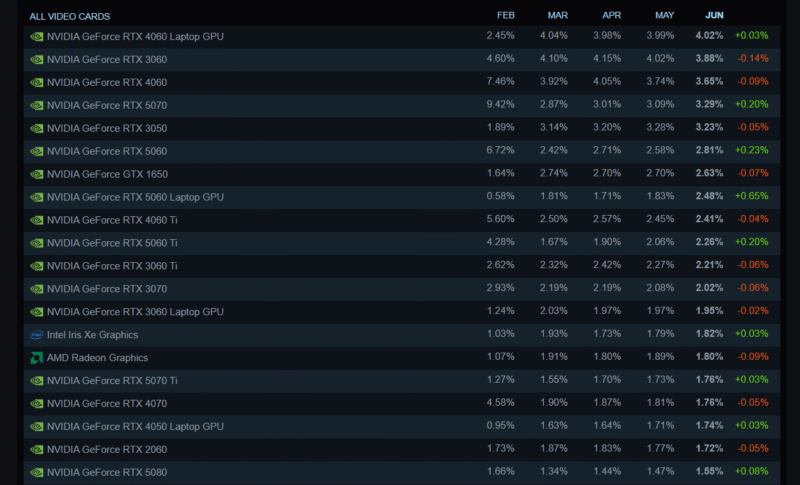
Rather than focusing on the fastest hardware available, it reveals what millions of gamers are actually using every day. The results are fascinating with the most popular a 4060 laptop GPU and the first high end GPU being the RTX 5080 is down at 20th place!.
While flagship graphics cards understandably receive the headlines, they represent only a tiny percentage of the overall PC gaming community.
Instead, the majority of players continue to use graphics cards such as:
- RTX 3060
- RTX 4060
- RTX 3070
- RTX 4070
- RTX 4060 Laptop GPU – Leading all of them July 2026.
- RTX 3060 Laptop GPU
These are excellent graphics cards and they power millions of gaming systems worldwide. More importantly, they represent the audience most likely to consider upgrading to dedicated simulation VR.
This observation completely changes the conversation.
Rather than asking – “Which headset offers the highest specifications?” perhaps we should ask:
“Which headset offers the best experience for the hardware most of us actually own?”
That, in my opinion, is a far more useful question.
YOUR NEXT FAVOURITE FLIGHT SIM GEAR IS WAITING!
Discover Premium Aviation Artwork, Apparel & Pilot Gifts at the LetsFlyVFR Etsy Store.


⭐⭐⭐⭐⭐ Trusted by Flight Simulation Enthusiasts Worldwide!
Now that we’ve explored why choosing a VR headset isn’t as simple as buying the one with the biggest numbers, it’s time to examine the amazing Pimax lineup itself.
What exactly separates the Crystal Light from the Crystal Super? Who should consider the Dream Air? Do flight sim pilots really need Lighthouse tracking?
And why do so many experienced simmers believe the Crystal Light may represent the sweet spot for today’s average gaming PC?
In Part One B, we’ll answer those questions by looking beyond the marketing specifications and focusing on what really matters: Finding the right headset for the way you fly.
Because in virtual reality, the best headset isn’t always the most expensive. It’s the one that lets you forget you’re wearing one at all.
Understanding the Pimax Lineup.
Now that we’ve explored why your PC should play a major role in choosing a VR headset, it’s time to look at one of the most exciting product ranges currently available to flight simulation enthusiasts.
Pimax has built its reputation by focusing on uncompromising visual quality for PC virtual reality. Rather than trying to be everything to everyone, its headsets are designed with enthusiasts in mind people who value image clarity, immersion, and long-term comfort above standalone gaming features or mobile applications.
While each headset has its own strengths, they all share a common goal of delivering an experience that brings you closer to the cockpit.
The important question isn’t simply, “Which Pimax headset is the best?”
It’s: “Which Pimax headset is the best for my computer, my budget, and the way I fly?”
The Crystal Light. The Sweet Spot for Most Flight Simmers
If there is one headset in the current Pimax family that immediately caught my attention, it’s the Crystal Light. At first glance, it may appear to be the “entry-level” member of the Crystal family, but I think that description undersells what it actually offers.
Instead, I’d describe it as the headset that strikes perhaps the best balance between visual quality, performance requirements, and affordability.
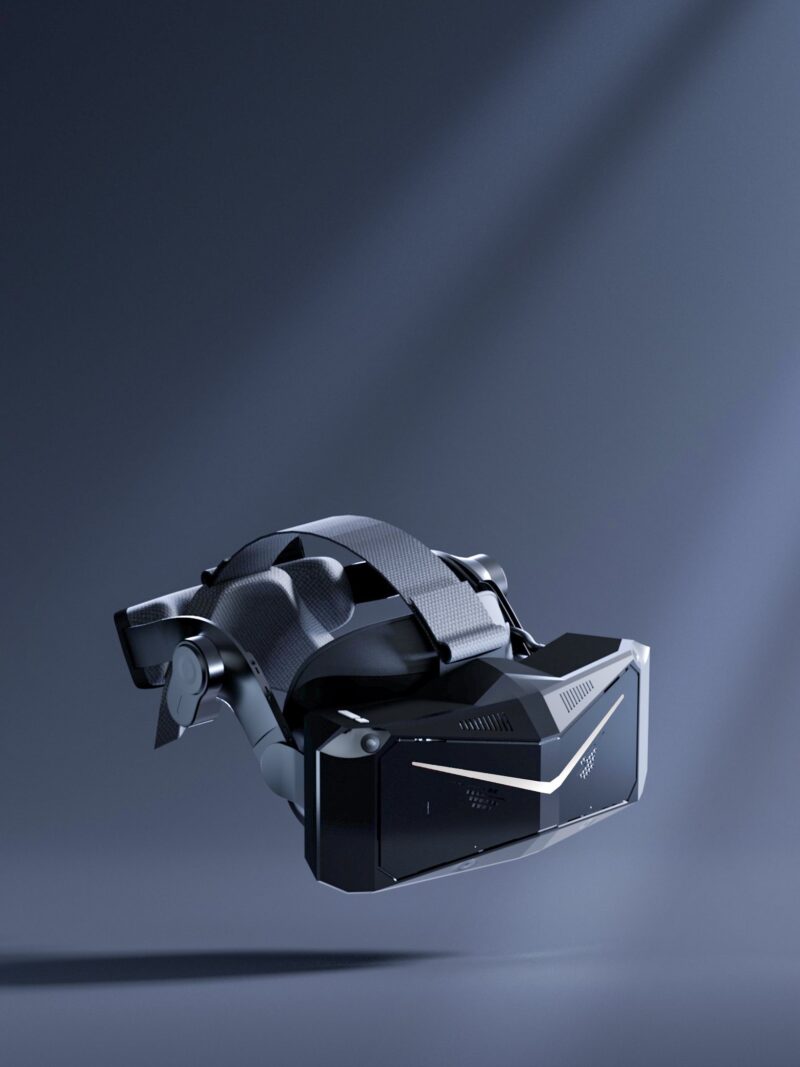
For flight simulation, balance is everything.
The Crystal Light focuses on the features that matter most to seated sim pilots:
- Exceptionally sharp cockpit clarity.
- High-quality optical design.
- DisplayPort connection for uncompromised PCVR image quality.
- Comfortable long-session use.
- Simplified setup compared with more complex VR systems.
Unlike standalone headsets, the Crystal Light is designed specifically for PC virtual reality. That means it isn’t carrying additional hardware needed for mobile gaming, batteries, or standalone operating systems such as the Meta Quest range. Instead, it concentrates its resources on delivering the highest possible visual fidelity from your gaming PC.
For someone who spends hours flying IFR procedures, practising air-to-air refuelling, or reading tiny cockpit displays, that focus makes a great deal of sense.
The Crystal Super – Pushing the Limits
At the other end of the range sits the Crystal Super. This headset represents Pimax’s pursuit of the highest levels of visual performance currently available for PCVR. Higher resolutions, advanced display technology, and premium features promise an extraordinary level of immersion but they also place correspondingly higher demands on the PC driving them.
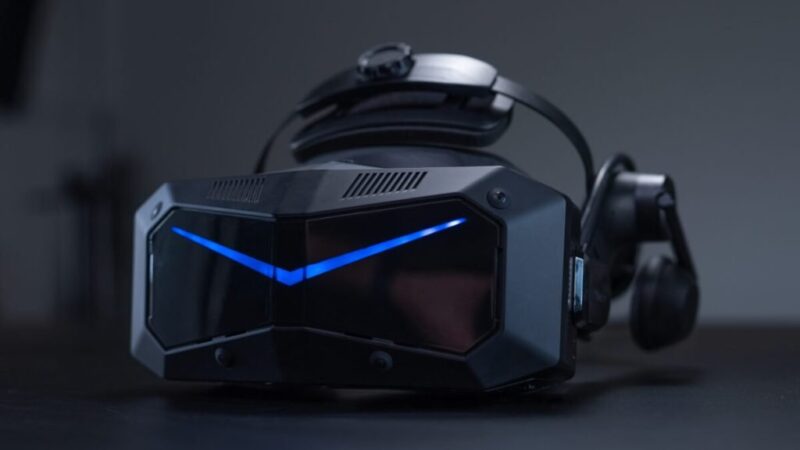
For owners of flagship hardware, that’s an exciting proposition. For everyone else, it raises an important question. Can your graphics card maintain the smooth performance that flight simulation demands? Modern flight simulators are already among the most demanding applications available. Adding an ultra-high-resolution headset increases that workload significantly.
That doesn’t make the Crystal Super the wrong choice.
It simply means that the headset is designed for a different type of user.
If your system includes one of today’s highest-performing graphics cards and a modern high-end processor, the Pimax Crystal Super may well deliver an incredible experience. If your hardware is more representative of the average gaming PC, however, you may actually enjoy a smoother and more consistent experience with the Pimax Crystal Light.
Sometimes, the best choice isn’t the most powerful one. It’s the one that allows your entire system to perform in harmony.
Looking Ahead – Dream Air.
Pimax has also generated significant interest with its Pimax Dream Air concept. While incredibly lightweight construction and advanced display technology are naturally attractive features, what interests me most isn’t simply how small the headset is.
It’s what reduced weight could mean during longer flying sessions. Anyone who has flown a two-hour cross-country flight in X-Plane or completed an extended multiplayer mission in DCS knows that comfort becomes increasingly important over time.
A lighter headset has the potential to reduce fatigue while maintaining the level of immersion serious simulation enthusiasts expect. As production hardware becomes available, it’ll be fascinating to see how this next generation develops.
Do Flight Simmers Need Lighthouse Tracking?
One specification that often causes confusion is tracking. Some VR systems rely entirely on external base stations commonly called Lighthouse tracking while others use inside-out tracking with cameras built directly into the headset. Flight simulation is different because we remain seated for the entire flight.
Our movements are limited to looking around the cockpit, checking mirrors, scanning for traffic, and occasionally leaning toward an instrument panel.
Inside-out tracking has matured enormously over recent years and, for many seated simulation enthusiasts, provides all the accuracy required without installing additional hardware around the room. That simplicity is another reason the Crystal Light appeals to me.
Why DisplayPort Still Matters!
One feature that deserves special attention is the continued use of DisplayPort for dedicated PCVR. This is always the better option for the best stability and clarity. I use the Meta Quest 3S with the PC connected directly to the PC and it works well most of the time.
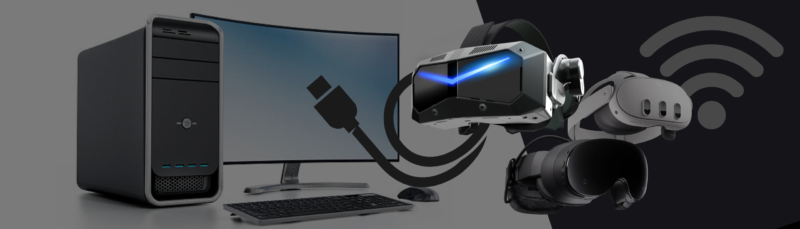
Wireless technology has improved dramatically and modern streaming solutions are impressive. But every wireless system introduces some degree of image compression and additional latency. For many games, that difference is barely noticeable.
A direct DisplayPort connection helps preserve image quality and minimise latency, allowing the headset to display exactly what your graphics card produces. For serious simulation enthusiasts, that’s a significant advantage.
Matching the Headset to Your Hardware.
This brings us back to the central theme of this article. Rather than asking which headset has the biggest numbers, ask which headset best matches your PC. Here’s how I currently see the landscape for dedicated flight simulation.
RTX 3060 / RTX 4060 Class
These systems represent a large proportion of today’s gaming community. While capable of excellent VR experiences, they benefit enormously from a headset that balances image quality with realistic rendering demands. The Crystal Light appears to be an excellent fit for this category.

RTX 3070 / RTX 4070 / RTX 5070 Class.
This is where I place my own system. These graphics cards offer significantly more performance while remaining representative of enthusiast gaming PCs rather than ultra-premium showcase builds. For this group, the Crystal Light continues to make enormous sense.
It delivers premium optics and visual quality while leaving valuable GPU headroom for higher simulator settings, complex scenery, weather, and multiplayer operations.
RTX 5080 / RTX 5090 Class.
This is the territory where flagship headsets can truly stretch their legs. If your entire system is built around extracting every possible pixel of performance, then higher-end Pimax models such as the CRYSTAL SUPER can stretch their legs and deliver unprecedented clarity and performance! .
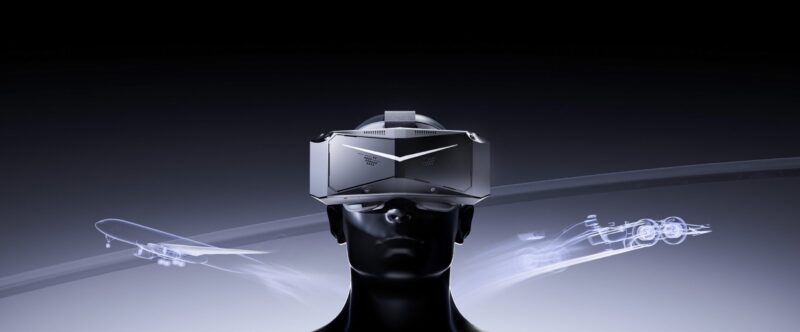
Even so, I’d still encourage buyers to consider how they actually fly. Smooth, consistent performance often contributes more to immersion than chasing the highest possible resolution.
My Honest First Impression.
Although I haven’t yet been able to experience the Pimax range, one conclusion already seems increasingly clear looking at the numbers. The Crystal Light isn’t simply a “cheaper Crystal Super.”
It appears to be a carefully balanced headset designed for the hardware that many enthusiasts actually own. That’s a philosophy I respect. Technology should enable immersion, not create unnecessary barriers to entry. For flight simulation, the goal isn’t to own the most expensive headset.
The goal is to disappear into the cockpit. If a headset allows you to forget about specifications and simply enjoy the experience of flying, then it has already achieved something remarkable.
Final Thoughts!
Virtual reality has matured enormously over the past decade. From the early days of first-generation consumer headsets through to today’s incredibly sharp displays and sophisticated optics, the progress has been remarkable.
Yet one lesson has remained constant. There is no universally “best” headset but there are a few amazing options on the table.
There is only the headset that best suits the individual pilot.
Your flying style.
Your simulator.
Your budget.
Your expectations.
And perhaps most importantly…
Your PC.
For many readers including myself that may ultimately make the Pimax Crystal Light one of the most compelling options currently available.
Not because it boasts the biggest numbers on a specification sheet, but because it appears to offer something arguably more valuable:
Balance.
And in flight simulation, balance is often the difference between admiring technology and becoming completely immersed in it.
If you have found this helpful and enlightening please leave me a comment below and tell me what you currently fly and what your considering upgrading too maybe?
Coming Next…
In the next article, we’ll move beyond product names and marketing terminology to explore the technology that actually creates the experience.
What exactly is Pixels Per Degree?
Why do lenses matter just as much as display resolution?
Is Micro OLED always better than QLED?
How much does Field of View really affect immersion?
And why can two headsets with similar specifications produce completely different experiences in the cockpit?
Understanding those answers will make choosing your next VR headset far easier and might even change the way you read specification sheets forever.



Author

Brendon McAliece (Aka Gunnie) is a military veteran with 23 years working on Jet Fighters, their weapons systems and ejection seat/module systems as well as munitions and R&D. Involved with flight simulation since the 1980s, he has flown all the major flight simulators over the years.
He is an Australian expat who has lived in Malaysia, UK, Saudi Arabia and more recently Thailand. He is a multi-lingual blogger who loves to share his life experiences here on LetsFlyVFR.com and DreamingGuitar.com, with his lifestyle and Travel experiences Blog plus his Dreaming Coffee website.
Learn More @
DreamingGuitar.com – DreamingCoffee.com
LetsFlyVFR ETSY Store – Discover PIMAX VR Now!

( HOME – BLOG – SHOP – ABOUT )
As an PIMAX affiliate I may benefit from qualifying sales.