
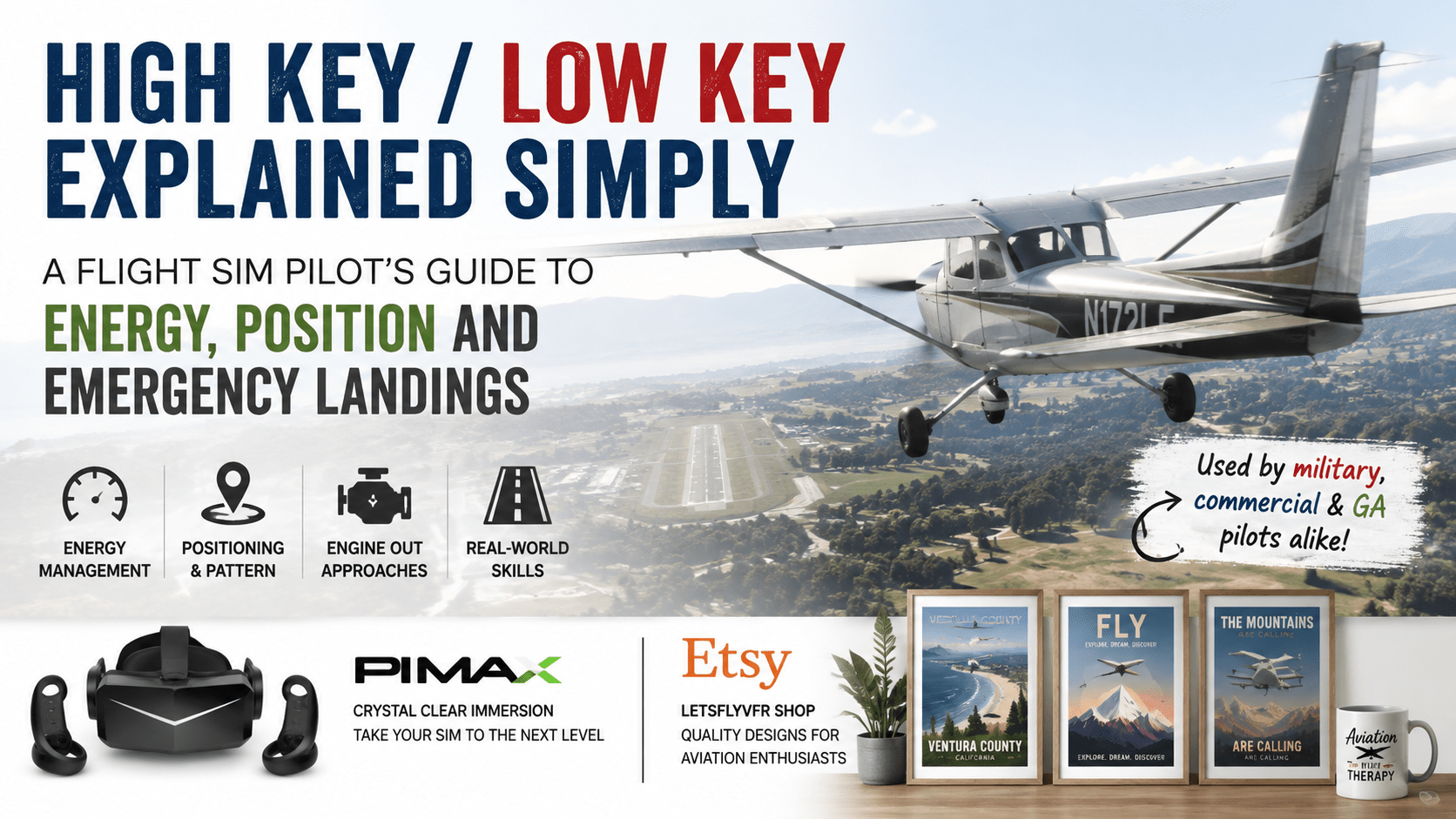
A Flight Sim Pilot’s Guide to Energy, Position and Emergency Landings.
If you’ve spent any time around military aviation, emergency procedures or advanced flight training, you’ve probably heard pilots talking about being “high key”, “low key”, or getting to the “key position.”
For a new flight simulator pilot, it can sound like another collection of mysterious aviation terms that professional pilots somehow expect everyone else to understand.
But the basic idea is actually very simple.
High key and low key are ways of describing where your aircraft is in relation to the landing area and, more importantly, how much altitude and energy you have available to reach it.
These concepts are particularly useful when discussing engine-out landings, power-off approaches, and traffic patterns.
And although the terminology is strongly associated with military aviation, the underlying principles apply to almost every aircraft.
Whether you’re flying a Cessna 172 in Microsoft Flight Simulator, a Spitfire in DCS, an F-16, an airliner, or a glider, the fundamental question is the same:
“If I lose my engine right now, where can I go, and how do I get there?”
For a flight simulator pilot, learning to think this way can dramatically improve your understanding of energy management and emergency procedures as well as survivability.
First Things First: Your Aircraft Is a Glider.
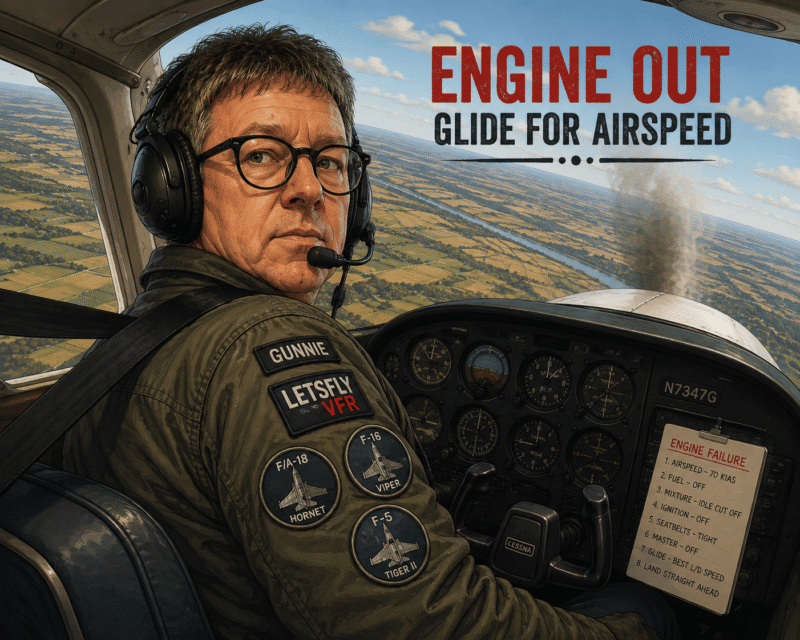
Let’s start with one of the most important concepts in aviation. If a powered aircraft suddenly loses its engine, it doesn’t immediately fall out of the sky. It becomes a glider.
The aircraft still has lift. It still has control authority. It still has airspeed. What it no longer has is thrust. That means your aircraft is now spending its stored energy to remain airborne. Altitude is essentially potential energy. Airspeed represents kinetic energy.
And your job as the pilot is to manage those two things carefully enough to turn altitude into distance and eventually into a landing.
This is why best-glide speed is so important.
The FAA specifically emphasizes the importance of pilots knowing and maintaining their aircraft’s best-glide speed during a power-loss emergency because poor speed control can significantly reduce the distance available for a forced landing.
Cessna 172 Best Glide: 68 KIAS
When practising a simulated engine failure in the Cessna 172, establish the aircraft at approximately 68 KIAS for best glide, then concentrate on selecting a suitable landing area.
The FAA also gives a useful rule of thumb that a Cessna 152/172 can glide about 1.5 nautical miles per 1,000 feet of altitude above ground level, although actual performance varies with aircraft configuration, weight, wind and conditions.
So when the engine quits, the first question isn’t:
“Where’s the airport?”
It is:
“Am I flying the aircraft correctly?”
Then:
“Where can I safely land?”

Take your cockpit to the next level with Pimax VR. From the exceptional value of the Crystal Light to the flagship Crystal Super and the revolutionary Dream Air, there’s a headset designed for every serious flight simmer.


Shop through our links below to unlock exclusive discounts and start flying in unparalleled clarity.
So What Exactly Is “Key”?
Think of key as a reference position.
It gives the pilot a point from which the remaining approach can be planned. Instead of simply flying around the airport and hoping the aircraft ends up over the runway, you’re deliberately positioning yourself so that you have a predictable amount of altitude and distance available.
The terminology is especially useful because it turns a complicated three-dimensional problem into something easier to visualize.
Imagine the runway below you.
You can think of the approach as a series of positions around the runway:
High Key → Low Key → Base → Final → Runway
The exact positions, altitudes and distances depend on the aircraft and procedure.
The important part is understanding the energy management behind them.
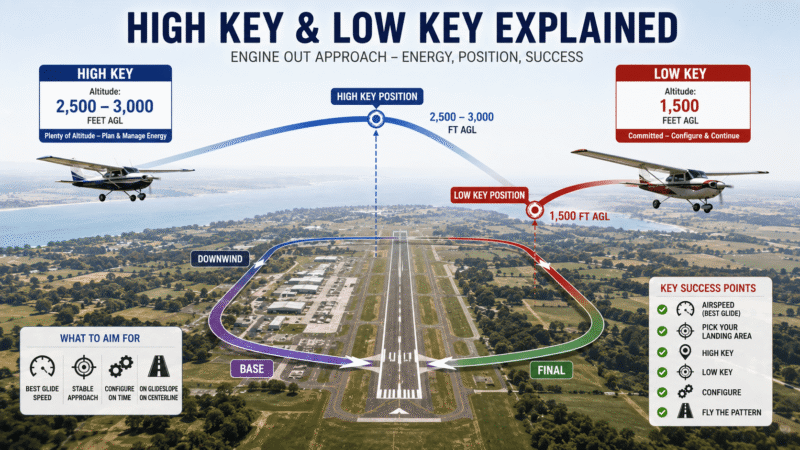
HIGH KEY.
“I’ve got plenty of altitude.”
High key is generally the higher reference position in an emergency or power-off approach.
You are relatively high above the landing area and have significant altitude available to trade for distance. This gives you options as well as you can make turns so as to adjust your pattern.
You can extend or shorten parts of the approach or you can use aerodynamic drag if necessary. But there is also a trap. Don’t spend more energy than you need to safely make the runway.
Being high isn’t automatically good.
If you are too high, you have too much energy and may have difficulty getting down to the runway without arriving too fast or too steep. This is where many simulator pilots make a mistake.
They think:
“I’ve got loads of altitude, so I’m safe.”
Not necessarily. Altitude is useful only if you can convert it into a controlled approach. If you’re extremely high and close to the runway, you may actually have too much energy. That means you may need to introduce drag, extend the pattern, use turns, slips, spoilers or other aircraft-specific techniques to dissipate energy.
The FAA’s guidance on simulated emergency approaches makes the same fundamental point: variables such as altitude, wind, obstacles, landing direction and aircraft landing performance determine the pattern that should be flown.
LOW KEY.
“Now I’m committed to the landing area.”
Low key is a lower reference position in the pattern.
By this point, the aircraft should be much closer to the landing area and the pilot should have a much better idea of whether the runway or selected landing area is reachable.
Think of low key as a decision and energy-management point.
You’re no longer asking:
“Can I get there?”
You’re increasingly asking:
“How do I arrive there correctly?”
The aircraft should be configured and positioned so that the remaining descent can be managed into the landing area.
Again, the exact altitude and position are aircraft- and procedure-specific.
There is no universal:
“Low key is always exactly X feet.”
That would be a dangerous way to teach the concept.
Instead, learn the numbers for the aircraft you’re actually flying.
HIGH KEY → LOW KEY → FINAL.
A very simple way to visualize the concept is this:
This isn’t a precise flight procedure.
It’s a mental model.
The aircraft is progressively converting altitude and airspeed into a controlled descent toward the landing area.
The Most Important Concept: ENERGY.
This is really what high key and low key are about.
Energy management.
Think of your aircraft as having an energy budget. At high altitude, you have a large amount of potential energy. As you descend, you’re spending that energy.
You can spend it in several ways:
- Flying forward
- Turning
- Climbing slightly
- Descending
- Increasing drag
- Extending landing gear
- Extending flaps
- Using speed brakes or spoilers where applicable
- Flying a longer or shorter pattern
Your objective is not simply to get down.
Your objective is to arrive at the runway with the correct amount of energy to make a safe landing.
That distinction is incredibly important.
TOO HIGH.
Let’s imagine your engine fails and you’re at 5,000 feet. You’re comfortably above the airport. You establish the aircraft’s recommended best-glide speed. You select a landing area & everything looks good but as you approach the airport, you realise something:
You’re much too high.
What can you do? You have several options depending on the aircraft and procedure. You can increase drag or you can fly a longer pattern or alternatively you can use turns or spirals.
Personal Experience:
You can use slips in suitable aircraft. Side slips are really effective and I used them when I ended up to high on approach. Its done by rolling left with the stick or yoke then balancing the rudder and push it the opposite way. It feels a bit strange initially so X Plane 12 is a great way to see how it works!
What this does is has you somewhat sideways, left wing low but not to much but you can see the runway plus the advantage the induced drag is making you descend much faster getting you to where you need to be.
You can extend the landing gear or flaps at the appropriate point. Military aircraft may have much more aggressive energy-management techniques available.
But the principle is the same:
Too much altitude means you need to dissipate energy.
The FAA specifically identifies slips, flaps, varying the base leg and changing the turn onto final as possible ways of correcting altitude and glide-angle misjudgments during simulated emergency approaches.
BUILD THE PERFECT COCKPIT… THEN DRESS THE PART!
Discover Premium Flight Simulator Apparel,
Wall Art, Pilot Gifts and Aviation Accessories






Shop the Collection Today ➜
@ LetsFlyVFR ETSY Store.
TOO LOW.
Now let’s reverse the situation because if the the engine fails your in more trouble. Fly your establish best glide. But you realise you’re already low then you don’t have much altitude to work with. This is where things become much more serious.
You have limited options.
You can’t simply make a giant 360-degree turn to lose altitude because you don’t have much altitude to lose. You need to protect the aircraft’s remaining energy. This is where airspeed discipline becomes critical.
Trying to stretch a glide by pulling the nose up and allowing the aircraft to slow below its recommended glide speed can actually make the situation worse. You aren’t magically getting more distance. You’re exchanging airspeed for altitude and potentially moving toward an aerodynamic stall. This is a serious situation.
The FAA’s emergency-approach guidance explicitly stresses maintaining the appropriate glide speed because variations in speed make judging glide distance much more difficult.
The Golden Rule
Here’s a simple rule that simulator pilots should remember:
Altitude gives you options. Airspeed gives you control.
Lose too much altitude and your options disappear. Lose too much airspeed and your ability to control the aircraft can disappear. The goal is to protect both.
WHAT DOES THIS HAVE TO DO WITH A NORMAL TRAFFIC PATTERN?
This is where high key and low key become particularly useful. You don’t need an engine failure to understand the concept. Every normal traffic pattern is really an exercise in energy management.
Consider a typical GA circuit:
Upwind → Crosswind → Downwind → Base → Final
As you fly the pattern, you’re constantly managing:
- Altitude
- Airspeed
- Configuration
- Distance from the runway
- Wind
- Turn radius
- Descent rate
- Energy
The same thinking applies to an emergency approach. The difference is that during a normal circuit, you have an engine available to help correct mistakes. During an engine-out approach, you don’t.
WHY MILITARY PILOTS TALK ABOUT HIGH KEY AND LOW KEY SO MUCH.
Military aviation takes this concept to another level. Fast aircraft have enormous amounts of energy. A fighter travelling at several hundred knots doesn’t behave like a Cessna.
If the engine fails, the pilot may have considerable kinetic energy but a rapidly changing energy state. Military pilots therefore train extensively in emergency patterns, including simulated flameout (SFO) procedures and emergency landing patterns.
The FAA’s air traffic procedures explicitly reference military fighter aircraft conducting flameout patterns when experiencing or anticipating loss of engine power.
This is where terms such as:
High Key
Low Key
Base Key
Final
These become particularly useful. They provide common reference points around the landing pattern. The exact geometry is determined by the aircraft, airfield, procedure and training syllabus.
SIMULATED FLAMEOUTS.
If you’re a DCS pilot, you’ve probably seen the term:
SFO — Simulated Flameout.
Despite the dramatic name, the idea is straightforward. The pilot practices an engine-out recovery without actually shutting down the engine. The throttle is reduced or the aircraft is otherwise placed into a simulated engine-out condition, and the pilot flies an emergency pattern toward the runway.
The FAA describes simulated emergency approaches as training designed to develop accuracy, judgment, planning, procedures and confidence when little or no power is available.
This is fantastic training for flight simulator pilots. Why? Because it forces you to stop relying on the throttle to fix every mistake.
TRY THIS IN YOUR SIMULATOR.
Pick a familiar aircraft.
A Cessna 172 is ideal then take off and climb to a safe altitude. You can then start flying back toward the airport & have a simulated flameout or engine failure.
Reduce the throttle to idle. Immediately establish the aircraft’s published best-glide speed.
Now ask yourself:
Where am I?
Where is the wind coming from?
Which runway gives me the best landing option?
Can I reach it?
Am I too high?
Am I too low?
Where is my key position?
Instead of immediately pointing the aircraft directly at the runway, start planning the approach.
DON’T CHASE THE RUNWAY.
This is one of the biggest lessons to learn. If you’re high, pointing directly at the runway may cause you to arrive over the runway with far too much altitude and energy.
If you’re low, constantly turning toward the runway may cause you to lose the airspeed and altitude you need to actually reach it. The better approach is to think in terms of energy gates.
You want to arrive at each stage of the pattern with approximately the amount of energy required for the next stage. That’s what the key positions are helping you achieve.
A SIMPLE WAY TO THINK ABOUT IT.
Imagine you’re throwing a paper aeroplane toward a target. If you throw it too high, it may overshoot but if you throw it too low, it won’t reach the target.
The skill is learning how much energy is required to get the aeroplane to exactly the right place. Your aircraft is doing essentially the same thing.
Except you’re controlling it with:
Pitch
Airspeed
Bank
Configuration
Drag
Wind
and altitude.
WHAT ABOUT WIND?
Wind can completely change your calculation. Imagine two aircraft at the same altitude, the same airspeed and the same distance from the runway. One is flying into a strong headwind & the the other has a strong tailwind. Their indicated airspeed might be identical.
Even if their glide performance through the air might be identical its likely their ground tracks and time to reach the runway will be very different.
This is why emergency landing planning must consider wind direction and strength. A strong headwind can help reduce groundspeed and shorten the distance required over the ground.
A tailwind can do the opposite as well as crosswinds can also affect your pattern geometry.
The FAA specifically recommends considering wind direction and estimating wind speed when planning simulated emergency approaches.
DON’T FORGET: BEST GLIDE IS AIRCRAFT SPECIFIC.
This is extremely important for flight sim pilots. Know your glide ratio and you’ll have a good indication of your glide distance. There is no universal best-glide speed.
A Cessna 172 has one speed, a Piper Cherokee has another with a glider yet another. An F-16 has completely different considerations to an airliner which has another set of procedures.
And the best-glide performance can change with:
- Aircraft weight
- Configuration
- Altitude
- Temperature
- Damage
- Stores
- Landing gear
- Flaps
- Wind
So don’t simply Google a number and assume it applies to your aircraft.
Read the aircraft’s manual.
For simulation, learn the published or aircraft-specific emergency procedure whenever possible.
THE “HIGH KEY” TRAP.
One of the most common misunderstandings is thinking:
High key = good.
Not necessarily because high key simply means you have a significant amount of altitude available. That’s useful but too much altitude can create a different problem as we discussed earlier. You need to convert it into distance and descent in a controlled manner.
Think of altitude like money & having money is useful. Having too much money in the wrong place doesn’t automatically solve the problem. Importantly you still need to spend it correctly.
THE “LOW KEY” TRAP.
Likewise:
Low key = almost there.
Not necessarily.
Low key means you’re further into the approach & you have fewer options.
At this stage, you should have a much better understanding of whether your landing area is achievable. But if you are too low or too far away, there may be little you can do to recover the situation. That’s why pilots constantly monitor their position and energy throughout the approach rather than waiting until low key to discover they’ve made a mistake.
WHY THIS MATTERS IN DCS.
For DCS pilots, high-key/low-key concepts are particularly valuable when flying modern fighter aircraft can travel enormous distances very quickly. They can also carry enormous amounts of kinetic energy. If you’re practicing emergency procedures in something like an F-16, F/A-18, F-5 or other military aircraft, the concepts of:
energy management
best glide
high key
low key
drag management
turn geometry
and final approach energy
become extremely useful.
A simulated engine failure is no longer just:
“Point at the runway.”
It’s a problem of managing the aircraft’s remaining energy.
That is a much more realistic way to approach the exercise.
AND IT MATTERS IN X-Plane & MSFS TOO!
The same principles apply to general aviation. Take something like a Cessna 152 or 172 out & fly a normal circuit. Now imagine the engine has failed. Suddenly your familiar traffic pattern takes on a completely different meaning. The downwind leg isn’t just a place where you fly parallel to the runway.
It’s an energy-management position.
Base isn’t simply where you turn. It’s another opportunity to judge whether you’re high, low, close, far, fast or slow. Final isn’t simply “line up with the runway.” It’s the final conversion of your remaining altitude and airspeed into a landing.
That’s what pilots mean when they talk about flying a disciplined pattern.
A GREAT SIMULATOR EXERCISE.
Here’s a simple exercise you can practice in almost any aircraft.
Exercise 1 — Normal Pattern.
Fly a normal circuit. Be comfortable with your climbs, turns, descents and touchdowns first. This is where X Plane can be of a lot of help getting the numbers in your head. This is also time to learn your VFR sight picture as you climb, descend and fly level.
Pay attention to:
- Pattern altitude
- Downwind spacing
- Base position
- Final turn
- Airspeed
- Descent rate
Then ask:
“If my engine stopped right now, could I still make the runway?”
Don’t actually simulate the failure yet. Just think about it!
Exercise 2 — Engine Failure on Downwind.
Now try it for real. Open X Plane up and select an airport. Its probably best to use a familiar one for the first few flights. I would recommend opening up the chosen aircraft, again I’d recommend the Cessna 172 to start.
In the settings if you want to set the failures so the engine will fail at say 1000Ft or after say 2 minutes. The other option is just to throttle down or turn the engine off manually. Its up to you!
Once your in the air:
Reduce power to simulate an engine failure. Immediately establish the aircraft’s recommended glide speed. Pick your landing area. Then build your approach around it.
Don’t panic.
Don’t immediately dive toward the runway just fly the aircraft & manage your energy.
REMEMBER – AVIATE – Navigate – Communicate
Exercise 3 — Start Too High
Try the same exercise from a higher altitude. Now you’ll discover the opposite problem and you have plenty of altitude. Can you get down without arriving over the runway with too much energy?
This teaches you how to dissipate altitude.
Exercise 4 — Start Too Low
Now try it from lower altitude. This teaches the opposite lesson so when you have very little energy available practice because you need to make decisions quickly.
You’ll discover why pilots don’t want to be unnecessarily low and far from a suitable landing area.
THE BIGGEST LESSON FOR FLIGHT SIM PILOTS.
The biggest lesson isn’t actually high key or low key. The lesson is energy awareness.
Good pilots are constantly asking:
“What does my aircraft have available to me right now?”
Not just:
“Where am I?”
Your altitude matters.
Your airspeed matters.
Your configuration matters.
Your distance from the runway matters.
The wind matters.
Your aircraft’s glide performance matters.
And all of those things are connected.
HIGH KEY AND LOW KEY IN ONE SENTENCE.
If we had to explain the entire concept to someone in one sentence:
High key and low key are reference points used to help a pilot manage altitude, airspeed and position so that the aircraft can arrive at the landing area with the right amount of energy.
That’s really all it is.
The terminology may sound complicated.
The concept isn’t.
FROM SIMULATOR PILOT TO PILOT THINKING.
One of the great things about flight simulation is that you can practice these concepts repeatedly without the real-world consequences of making a mistake.
You can deliberately put yourself in difficult situations.
You can practice engine failures.
You can practice different winds.
You can try different aircraft.
You can see what happens when you’re too high.
You can see what happens when you’re too low.
And, most importantly, you can start developing the habit of thinking ahead of the aircraft.
That’s a skill that transfers remarkably well between simulator flying and real aviation.
A FINAL WORD OF CAUTION.
There is one important qualification.
High key and low key are not universal fixed altitudes or positions.
Military emergency patterns, GA traffic patterns, glider procedures and airline operations can all use different terminology, geometry and numbers. Aircraft performance is also dramatically different.
So use this article to understand the concept, not as a substitute for the aircraft’s Pilot Operating Handbook, flight manual, checklist, instructor or published emergency procedure.
In real flying, the aircraft-specific procedure always wins. And in the simulator, learning the actual procedure for the aircraft you’re flying is part of the fun.
THE TAKEAWAY.
The next time you’re flying around an airport in your simulator, don’t just think about where you are.
Think about where your energy is.
Ask yourself:
Am I high or low?
Am I fast or slow?
Where is the wind taking me?
Could I reach the runway without power?
Where would my key position be?
Do I have too much energy or too little?
And perhaps the most important question:
If the engine stopped right now, what would I do?
That’s the mindset that turns a simulator pilot from someone who simply knows how to fly the aircraft into someone who understands why the aircraft is being flown that way.
And that’s exactly what High Key / Low Key is all about.
Further Reading.
The FAA’s Airplane Flying Handbook contains detailed guidance on traffic patterns, approaches, emergency approaches and landings, including simulated power-off approaches.
The FAA also provides guidance on best-glide speed and distance, emphasizing the importance of understanding an aircraft’s optimum glide performance during a power-loss emergency.
For military aviation enthusiasts, FAA air-traffic guidance also explicitly discusses simulated flameout approaches and emergency landing patterns used by military fighter-type aircraft.
Remember: In the simulator, practice makes perfect. In the real aircraft, your POH/AFM and instructor make the rules.
Author
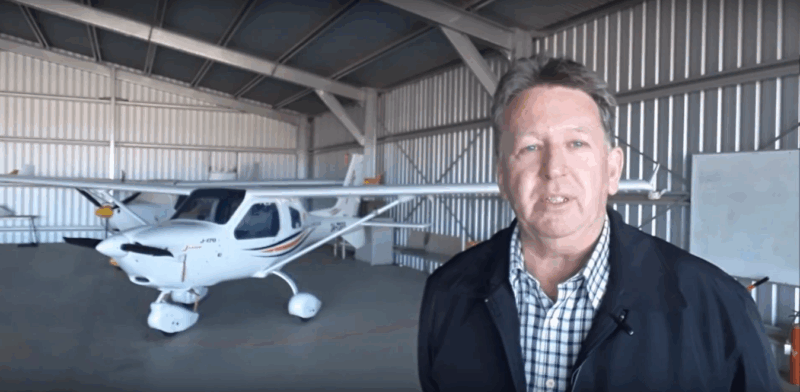
Brendon McAliece (Aka Gunnie) is a military veteran with 23 years working on Jet Fighters, their weapons systems and ejection seat/module systems as well as munitions and R&D. Involved with flight simulation since the 1980s, he has flown all the major flight simulators over the years.
He is an Australian expat who has lived in Malaysia, UK, Saudi Arabia and more recently Thailand. He is a multi-lingual blogger who loves to share his life experiences here on LetsFlyVFR.com and DreamingGuitar.com, with his lifestyle and Travel experiences Blog plus his Dreaming Coffee website.
Learn More @
DreamingGuitar.com – DreamingCoffee.com
LetsFlyVFR ETSY Store – Discover PIMAX VR Now!

Leave a Reply