
Fence In Checks & Fence Out Checks.
Fence In:
Prior to entering the working areas and commencing manoeuvres, the
Lead shall direct the flight to fence-in over Tac Freq.
Lead SNFO (Aux) – “TURBO, switch button 18, Fence In”
Wing SNFO (Aux) – “Two”
Each SNFO will be responsible for completing the A/A combat checks:
i. A/A TACAN – Set/Receiving/TACAN Boxed
ii. HUD A/A Mode – Select (MENU/STRS/ A/A)
iii. A/A Gun Mode – Select RTGS
iv. Wingspan – Verify 31 feet
v. Master Arm – As Briefed (direct IP to arm up)
vi. Tapes – VCR Check ON (direct IP/verify BIT page)
vii. IFF – As assigned
The Lead SNFO will initiate the fenced report, with alibis, over the Tac Freq after
completion of the G-Warm.
Lead SNFO (Aux) – “TURBO 11, Fenced In, 2.5″
Wing SNFO (Aux) – “TURBO 12, Fenced In, 2.4, negative yardstick.”
Fencing Out:
Upon completion of the BFM conduct and safe join up, the Lead SNFO will direct the
flight to fence out.
(W-155A)/Approach (PNSS MOA):
Lead SNFO (Aux) – “TURBO, switch button 15 Pri, fence out”
CHAPTER THREE ADVANCED UMFO BFM AND AWI
3-20 BASIC FIGHTER MANEUVERING (BFM) PROCEDURES
Wing SNFO (Aux) – “Two”
Each SNFO will be responsible for setting up the aircraft for the admin RTB:
i. TACAN – A/A Deselected/Set/Receiving
ii. HUD Mode – NAV Mode
iii. IFF – Wingman Standby
iv. Master Arm – Safe (direct IP to safe up)
v. Tapes – VCR Check Off (direct IP/verify BIT page)
vi. Fuel – BINGO Setting set to “Divert” setting
Once both aircraft are fenced out and safely rendezvoused, the Lead SNFO will
initiate the “Fenced Out” report.
Lead SNFO (Aux) – “TURBO 11, fenced out, 1.0″
Wing SNFO (Aux) – “TURBO 12, fenced out, .9”
After reporting completion of the fence out checks, Lead IP will initiate Battle Damage Checks
(BDC). It is very important to confirm “fenced out” and all switches safe prior to manoeuvring under each other’s aircraft.
Radio Terminology.
COMM Brevity
To further enhance section communication, the fighter community has carefully defined tactical
in-flight terminology. Utilizing the correct word or phrase will greatly increase situational
awareness during an engagement. The following is a list of standardized terminology:
a. Bandit – Known enemy aircraft; does not necessarily give us authorization to employ
weapons.
b. Hostile – A BANDIT whose engagement ROE has been met, allowing us to employ
weapons.
c. Bogey – A radar/visual contact whose identity is unknown.
d. Tally – Sighting of a target/bandit/bogey; opposite of “NO JOY”
e. Visual – Sighting of a friendly aircraft; opposite of “BLIND” (typically used during
1v1 BFM as our opponent is actually still our Wingman)
f. No joy – No visual contact with target/bandit/bogey; opposite of “TALLY”
g. Blind – No visual contact with friendly aircraft; opposite of “VISUAL” (typically
used during 1v1 BFM as our opponent is actually still our Wingman)
h. Knock-It-Off – Term used to stop an entire multi-plane engagement/exercise. In the
context of 1v1, used to end a specific engagement/exercise (i.e., Snapshot Drill)
Flying Scenarios.
Perch Setups:
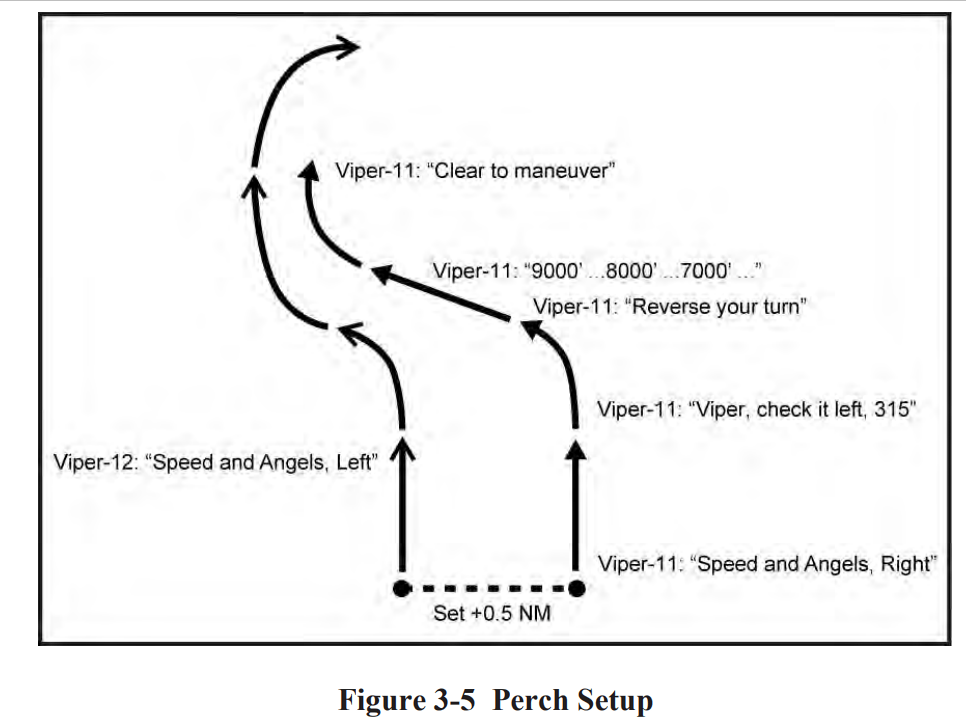
Figure 3-5 illustrates the procedural format used for all Perch setups to include:
a. Tail Chase Exercise
b. Offensive/Defensive Manoeuvres
c. Intro-to-Ds
d. Uncalled Ds
e. Offensive/Defensive Perch Sets.
Aircraft will start abeam, co-altitude (15K’ or 18K’, drill dependent), at a half a mile farther than the desired perch distance. The offensive aircraft will pull nose-on and call for the defender to reverse the turn. The offensive aircraft will call out ranges in thousands of feet until the desired range where “Fox-2” (with a valid shot) or “clear to manoeuvre” is called. At the “Fox-2,” the fight is on and the SNFOs will initiate their comm sequence.
Butterfly Sets:
High Aspect Sets
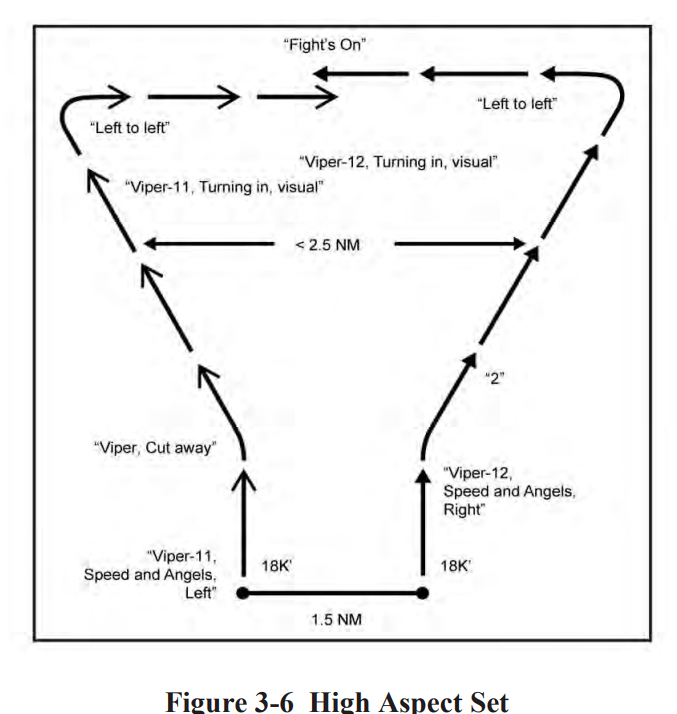
All High Aspect sets will utilize Butterfly Sets (Figure 3-6) to ensure a neutral sight picture at the merge. The Instructor Pilots (IPs) will transmit all high aspect direction-of-pass calls over PRI to ensure safety of flight.
Pass calls will be made to “maintain the established trend” as per training rules; do not cross flight paths to force a particular merge.
The PADS for the high aspect sets are: 18K’, 300 KTS, 1.5 NM.
Lead IP initiates a 30 degree cut away for both aircraft to establish
roughly 2.5 NM separation. Prior to 2.5 NM or no later than either aircraft losing sight, either IP can call “turning in, visual” to be echoed by other aircraft.
Knock It Off Call!
Knock-it-Off – Knock-it-Off – Knock-it-Off
The highest potential for a mid-air collision in the BFM arena exists after the knock-it-off. This is because both aircraft are in close proximity at potentially low energy states and no predictable flow exists.
Lets BFM Basic Fighter Manoeuvres.
In this section we will look at the different engagements and compliment them with downloadable DCS WORD Mission files you can upload to your mission folder and fly.
Rules:
OFFENSIVE/DEFENSIVE BFM
Offensive and defensive BFM principles provide the foundation of air combat manoeuvring.
Regardless of the degree to which you are offensive or defensive in an engagement, the
overarching goals remain the same:
Offensive Goals:
- Preserve lateral separation/turning room (Control RAC)
- Pressure the defender
- Maneuver to arrive in the control zone
- Employ weapons
Defensive Goals: - Deny weapons employment opportunities
- Collapse the fight, denying angles/turning room
- Create fuselage misalignment
- Separate/Neutralize/Kill
Specifically, for defensive BFM, there are four axioms that support the defensive goals:
- Maneuver to Survive: Recognition of “sensor nose” and responding with break turns
or Guns ‘D’ as appropriate. - Attacker outside the Bubble: Pull Attacker as Far Forward as Possible
a. Sensor nose-on = break turn (19-21 units)
b. Sensor nose-off = hard turn (17 units) - Attacker Inside the Bubble: Decrease in Target Aspect = Increase in pull – and vice
versa. - Sensor nose-on and Cannot Pull Forward of 3/9 Line = Redefinition/Ditch
Exercise 1 –
9,000 Feet (9K’) Perch Set Offensive
The attacker begins the 9K’ set Outside the Bubble; the offensive objectives are:
a. Bubble entry
b. Attack Window Entry Mechanics (Mech)
c. Rate war/misaligned turn circles
d. Second Bubble entry
Leave a Reply