
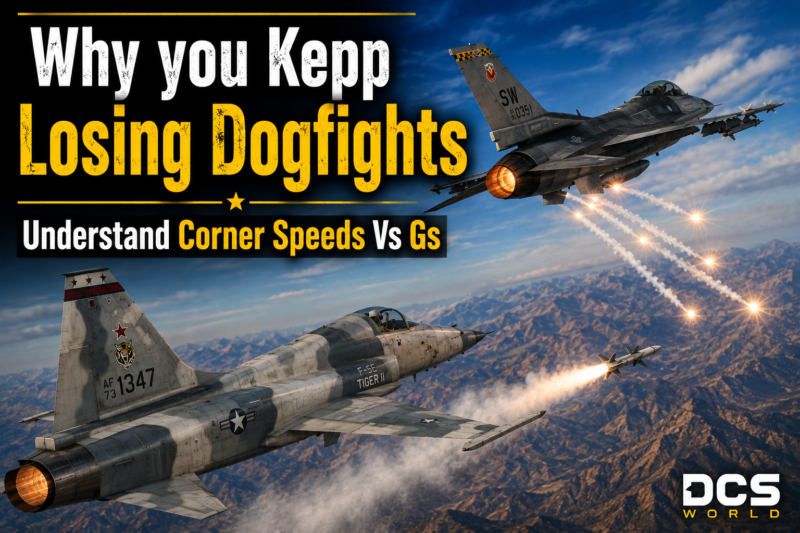
If you’ve ever jumped into the Northrop F-5E Tiger II or any aircraft in DCS World and thought:
“Why can’t I hold max G like an F-16?”
“Why do I lose all my speed in turns?”
“Everyone says ‘rate fight’ and ‘corner speed’ — but what does that actually mean?”
—you are not alone.
This is one of the biggest misunderstandings new DCS pilots face when learning BFM (Basic Fighter Maneuvers). Many players hear experienced pilots constantly talking about:
- “sustained 9 G,”
- “corner velocity,”
- “max rate,”
- or “holding G,”
…but very few explain how these concepts actually connect together.
The result?
New pilots often fly the F-5 completely wrong:
- yanking maximum stick,
- bleeding all their energy,
- getting slow,
- and becoming an easy kill for more advanced fighters.
The good news is:
once you understand the relationship between speed, G, turn rate, and energy, dogfighting suddenly starts making sense.
And the Northrop F-5E Tiger II becomes one of the most rewarding aircraft in DCS to fly well.
The Biggest Myth in DCS Dogfighting.
Many new players believe:
“More G always means a better turn.”
That sounds logical — but it is incomplete.
Because in reality:
G by itself means almost nothing.
You can pull:
- 9 G at 500 knots,
- or 9 G at 250 knots,
and those are completely different situations.
What actually matters is:
- how FAST your aircraft is turning,
- how much ENERGY you retain,
- and whether you can SUSTAIN the maneuver.
This is where the real concepts begin.
Understanding the Four Things That Actually Matter.
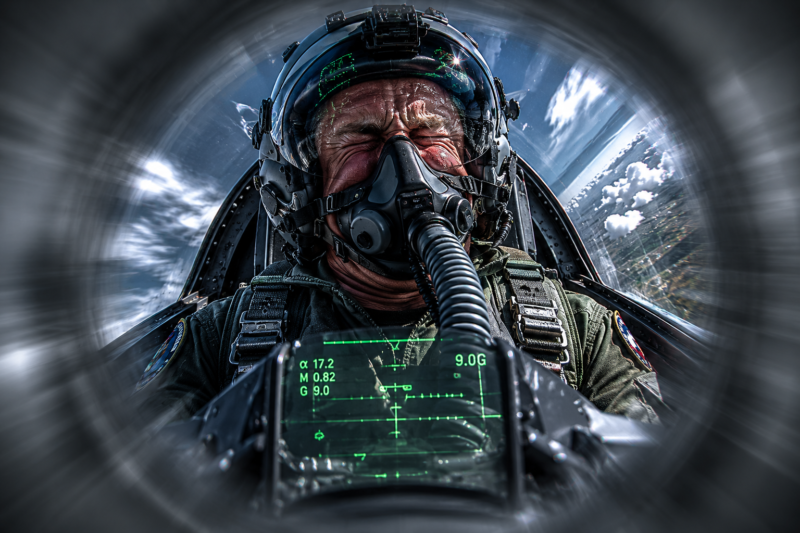
Every dogfight revolves around four connected ideas:
1. G Load
This is simply:
how hard the aircraft is pulling.
More stick = more lift = more G.
But more G also creates:
- more drag,
- more energy loss,
- and more speed bleed.
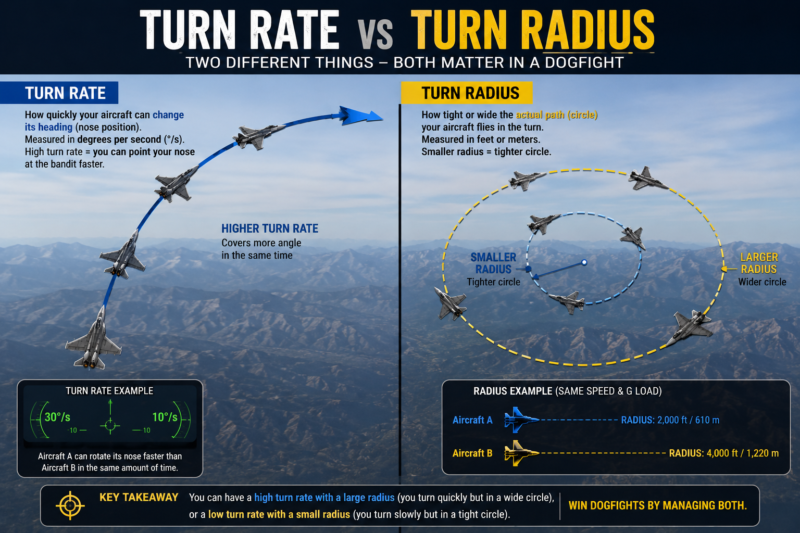
2. Turn Rate
This is:
how quickly your nose rotates around the sky.
This wins rate fights.
A fighter with a better sustained turn rate can slowly gain angles over time.
3. Turn Radius
This is:
how tight your turn circle is.
Small radius helps in:
- one-circle fights,
- overshoots,
- close-in maneuvering.
4. Energy
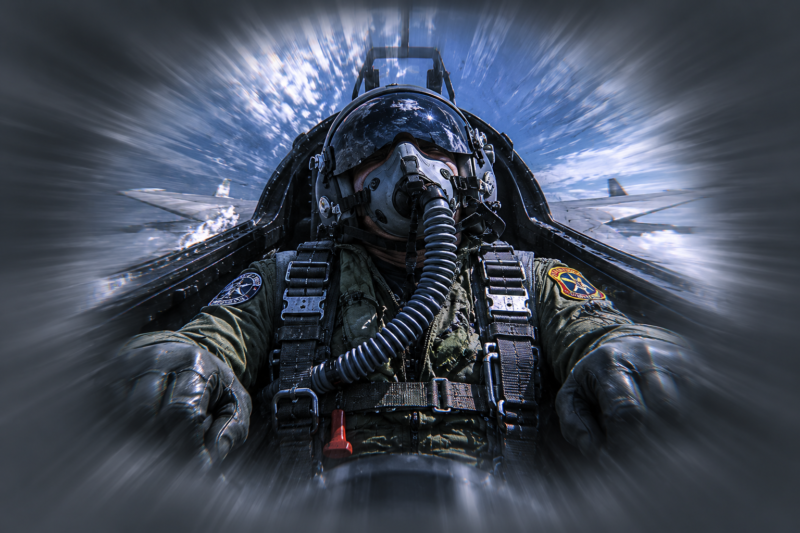
This is your:
- speed,
- altitude,
- and ability to maneuver.
Energy is life.
Lose too much of it, and even the best turner becomes helpless.
Why Speed Matters More Than Most New Pilots Realize.
This is the key concept many beginners miss:
Speed creates turning performance.
The faster the aircraft moves:
- the more airflow passes over the wings,
- the more lift becomes available,
- and the more G the aircraft can support efficiently.
That is why aircraft like the General Dynamics F-16 Fighting Falcon can sustain enormous G loads:
- massive engine power,
- advanced aerodynamics,
- fly-by-wire systems,
- and huge excess thrust.
The F-5 is very different.
It is lightweight and agile…
but it does NOT have excess power.
That means:
The F-5 cannot maintain high G for long without bleeding energy rapidly.
And this is completely normal.
Instantaneous Turn vs Sustained Turn.
This is one of the most important concepts in air combat.
Instantaneous Turn
This means:
“How hard can I pull RIGHT NOW?”
Usually:
- high speed,
- aggressive pull,
- maximum nose authority.
This is useful for:
- snapshots,
- defensive breaks,
- forcing overshoots,
- quick missile opportunities.
For the F-5, this often happens around:
- roughly 420–450 knots IAS.
At these speeds the aircraft can produce very aggressive nose authority temporarily.
But:
- you cannot maintain it for long.
The aircraft will rapidly lose energy.
Sustained Turn.
This means:
“What can I hold continuously without slowing down?”
This is the true measure of a rate fighter.
For the F-5, the practical sustained fighting region is usually around:
- 330–380 knots IAS.
Notice something important:
that does NOT mean:
“Hold maximum stick all the time.”
It means:
- the aircraft remains efficient,
- controllable,
- responsive,
- and energy-stable in this region.
A good F-5 pilot is constantly:
- loading G,
- unloading slightly,
- then reapplying pressure.
The aircraft rewards smoothness, not brutality.
Why the F-5 Feels So Different From Modern Fighters.
Modern fighters like the:
- McDonnell Douglas F/A-18 Hornet
- General Dynamics F-16 Fighting Falcon
- Dassault Mirage 2000
can often sustain extremely high G loads because they possess enormous thrust and advanced flight control systems.
In many modern jets:
the pilot reaches the G limit BEFORE the aircraft runs out of power.
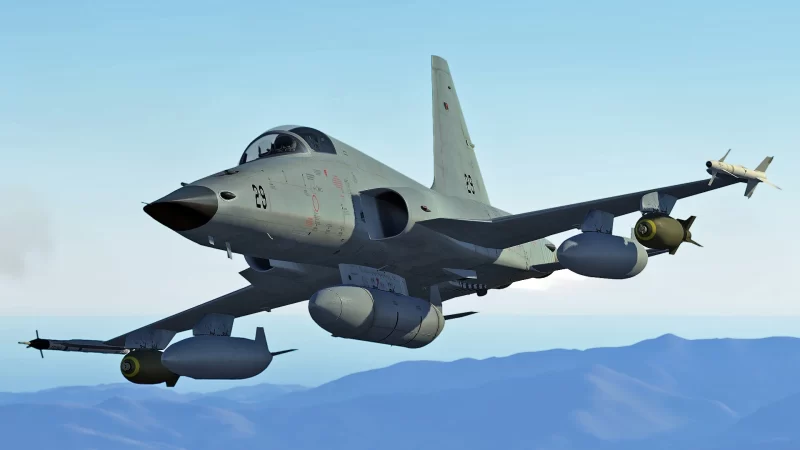
In the F-5:
you usually run out of energy BEFORE reaching structural or pilot G limits.
That is a massive difference.
The Tiger II is an old-school energy fighter.
It demands:
- patience,
- geometry,
- discipline,
- and smooth control inputs.
The F-5 Sweet Spot in DCS.
These are not exact “magic numbers,” but they are excellent practical references:
| Situation | Typical Speed |
|---|---|
| Hard merge / instantaneous pull | 420–450 knots |
| Sustained maneuvering / rate fight | 330–380 knots |
| Danger zone | Below 300 knots |
Below 300 knots:
- acceleration becomes poor,
- energy recovery becomes difficult,
- and modern fighters gain huge advantages.
This is where many new pilots die.
The Beginner Mistake That Kills Most F-5 Pilots!
New players often try to fly the F-5 like an F-16.
They:
- pull maximum stick,
- hold max AoA,
- chase nose position,
- and ignore energy state.
The result:
- massive drag,
- rapid deceleration,
- loss of turn rate,
- and eventually becoming trapped slow.
A skilled F-5 pilot instead thinks:
“How can I keep the aircraft efficient?”
Sometimes:
- 5.5 G at 360 knots
is FAR stronger than: - 7 G at 290 knots.
Because the first pilot:
- maintains turn rate,
- keeps options open,
- and preserves maneuvering energy.
Fighting More Advanced Fighters in the F-5.
The F-5 does not win through raw power.
It wins through:
- forcing mistakes,
- creating overshoots,
- denying easy shots,
- and dragging opponents into uncomfortable close-range fights.
Against aircraft like:
- Mikoyan MiG-29
- General Dynamics F-16 Fighting Falcon
- Dassault Mirage 2000
you should avoid prolonged vertical fights.
Their thrust advantage is enormous.
Instead:
- stay unpredictable,
- use rolling scissors,
- force one-circle geometry,
- and make them overshoot.
Against the:
Mikoyan MiG-21
you can often out-handle them in sustained maneuvering if you remain disciplined and energy-aware.
The Real Secret to Winning in the F-5.
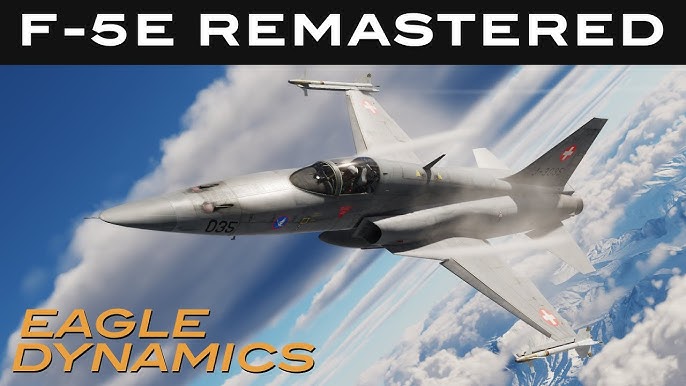
The best F-5 pilots rarely look dramatic.
They are:
- smooth,
- patient,
- efficient,
- and constantly managing energy.
They understand:
Dogfighting is not about pulling the MOST G.
It is about:
pulling the RIGHT amount of G for the situation.
And once that finally clicks…
the F-5 transforms from:
“underpowered and frustrating”
into:
one of the purest and most rewarding dogfighters in DCS World.
Final Advice for New F-5 Pilots.
If you remember only one thing from this article, remember this:
“Speed is the fuel for turning performance.
G is simply how hard you spend it.”
Master that concept…
and you will already understand dogfighting better than most new DCS players.
Author
Brendon McAliece (Aka Gunnie) is a military veteran with 23 years working on Jet Fighters, their weapons systems and ejection seat/module systems as well as munitions and R&D. Involved with flight simulation since the 1980s, he has flown all the major flight simulators over the years.
He is an Australian expat who has lived in Malaysia, UK, Saudi Arabia and more recently Thailand. He is a multi-lingual blogger who loves to share his life experiences here on LetsFlyVFR.com and DreamingGuitar.com, with his lifestyle and Travel experiences Blog plus his Dreaming Coffee website.
Learn More @
DreamingGuitar.com – DreamingCoffee.com – LetsFlyVFR.com
( HOME – BLOG – SHOP – ABOUT )
As an Amazon affiliate I may benefit from qualifying sales.