
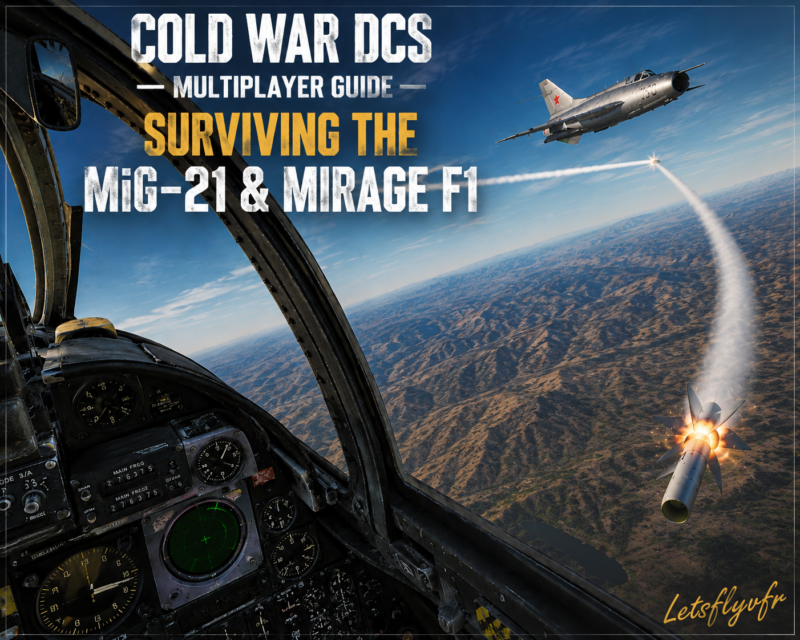
A Tactical Survival Guide for F-5E Pilots
Win the fight before the missiles leave the rails.
Introduction
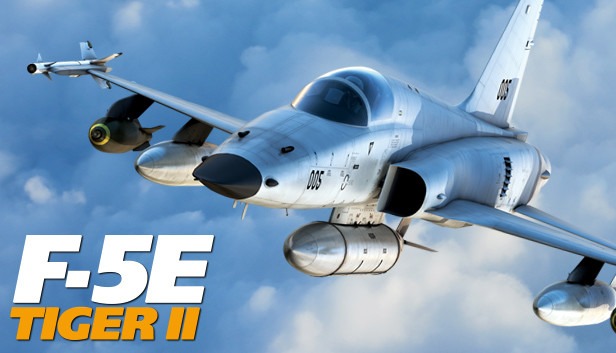
Many F-5E pilots focus on defeating missiles and personally I’ve been getting my but kicked till I did some more research to understand the while Cold War DCS missile defence picture and remind myself of the basic radar defence techniques. I had more of a guns only mentality which proved to be wrong!
In the Cold War scenario its easy to forget Fox 1 radar guided missiles exist when you driving around the sky in Your Fox 2 armed F-5 Tiger II or even a Mig-15 against an F-4 – F-1 & Mig-21.
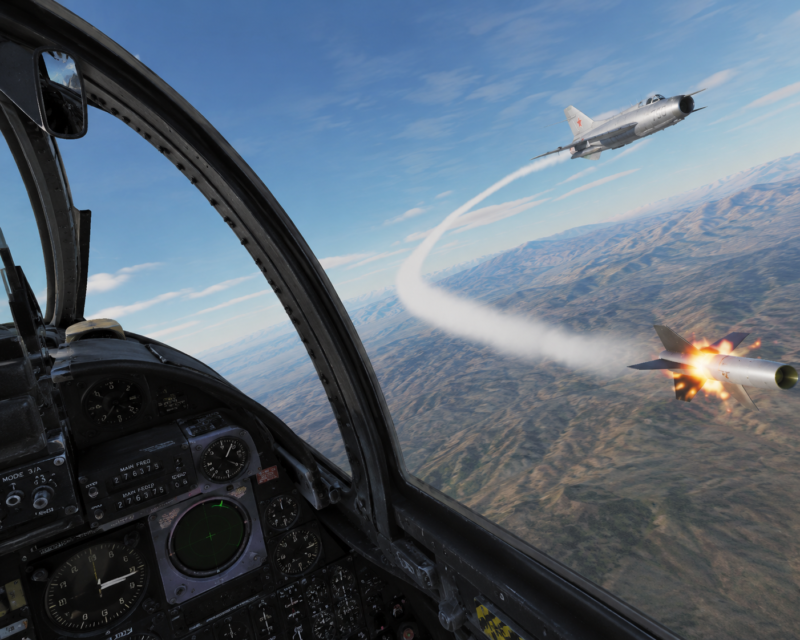
Experienced Cold War pilots focus on preventing the launch which is really putting you behind the eight ball so to speak. If your getting a Radar lock indication then you need to be reacting immediately!
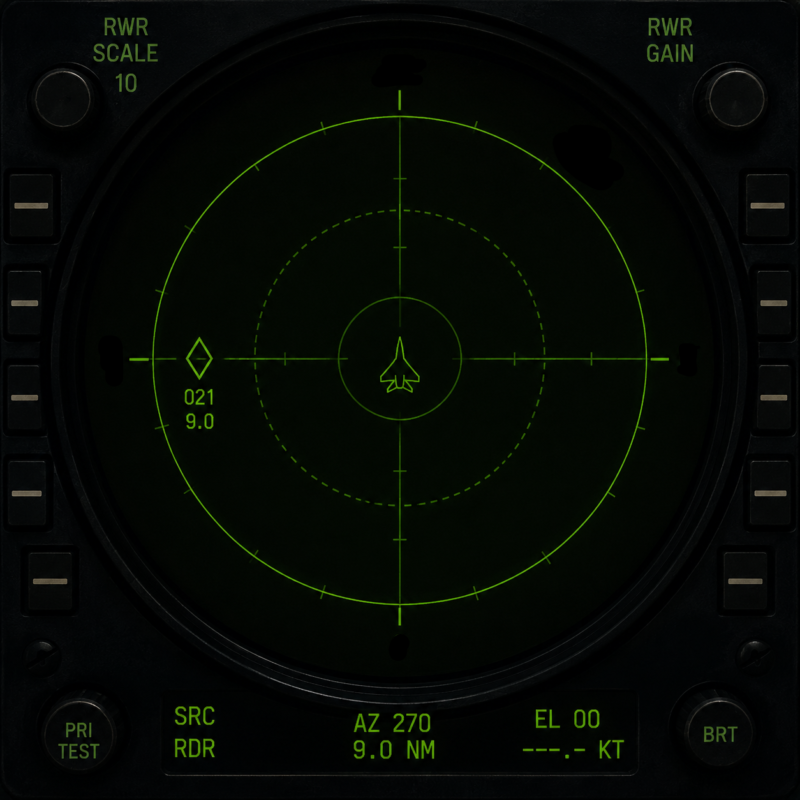
The MiG-21 and Mirage F1 are among the most dangerous opponents on Cold War (Blue) multiplayer servers because both can kill an inattentive F-5 very quickly. Their radar capabilities and missile options mean you need to be notching the missile and radar as soon as there is a lock indication.
The MiG-21 is often underestimated and the Mirage F1 is often over-committed against. Both mistakes get F-5 pilots killed.
This guide focuses on surviving and defeating these aircraft in multiplayer environments such as Heatblur’s Cold War servers and similar 1970s–1980s scenarios.
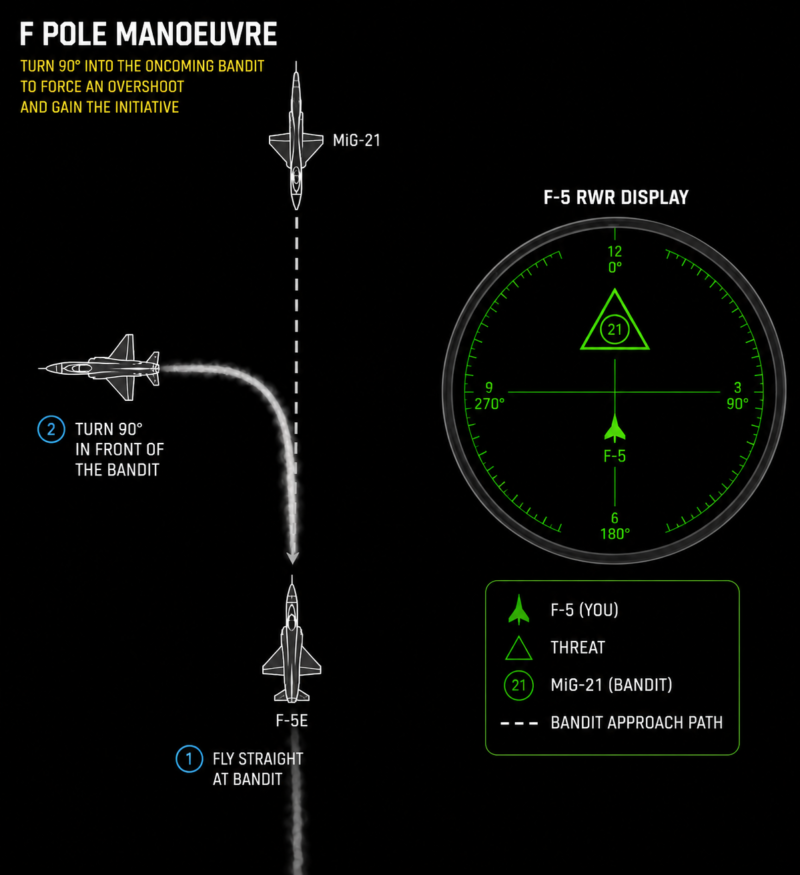
The F Pole Manoeuvre – Break the Radar Lock!
The F pole Manoeuvre is a simple and effective way to break lock and therefor avoid any missiles already heading in your direction. The initial breaking of the radar lock lets you escape the missile if already launched as well as giving you time for tactical decisions.
Why Does This Work?
Early pulse doppler radars rely on movement either towards them or away them them, so they send out rapid pulses and then measure the difference in closure or departure rates to get a picture. The radar calculation removes its own onboard airspeed and only compares the closure of another object again towards or away from it only.
In the F Pole we reduce our closure to a minimal by having no closure speed so the radar then loses it’s lock. It’s easy and once the lock indication is gone you can manoeuvre once again and get aggressive.
Missile Avoidance
Missile avoidance is possible against Fox 1 missiles in Cold War scenarios and, to a lesser extent, against modern radar-guided missiles. However, it becomes progressively more difficult as missile technology improves.
If you’re new to DCS World, it is important to understand that missiles do not fly like they do in Hollywood movies. During my Air Force days loading these missiles, one of the biggest misconceptions people had was that missiles simply chased aircraft around the sky like a rabid dog.
In reality, missiles are much smarter than that.
When a missile is launched, it knows where it is, where the target is, and the direction the target is travelling. Using this information, the missile calculates an intercept course. Rather than chasing your current position, it flies toward where it predicts you will be in the future.
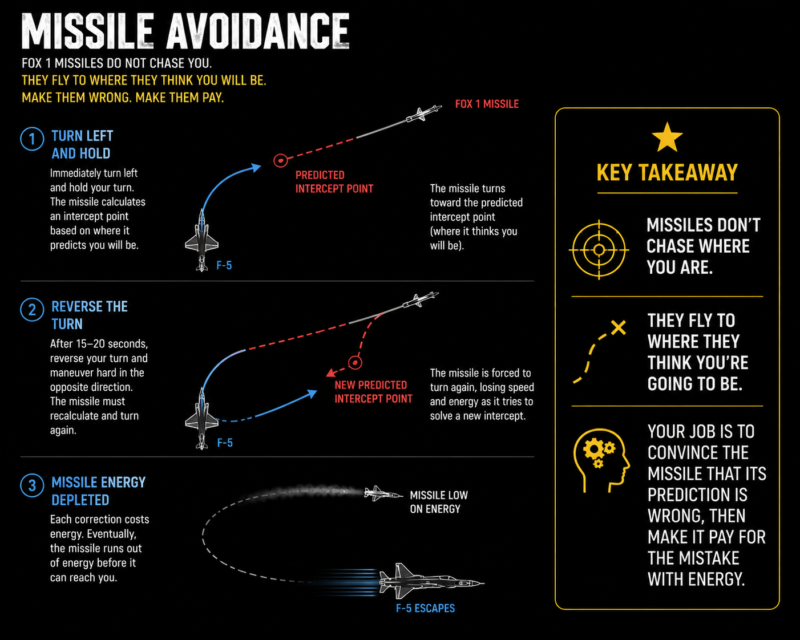
This creates an opportunity.
Imagine a radar-guided missile launched at medium range in a Cold War scenario. If you immediately begin a sustained turn to the left, the missile will calculate a new intercept point and begin manoeuvring toward where it expects you to be.
The key is patience.
Continue the turn long enough for the missile to commit to that intercept solution. Once the missile has expended energy turning and correcting its flight path, reverse the turn and manoeuvre hard in the opposite direction.
The missile must now recalculate another intercept point and manoeuvre again. Every correction costs energy. Unlike an aircraft, a missile has a finite amount of fuel and only a limited ability to manoeuvre.
LetsFlyVFR.com Clothing & Gift Shop (ETSY.com)

By forcing the missile to make multiple large corrections, you can dramatically reduce its energy. In many cases, particularly with older Cold War missiles, the weapon may run out of energy before it can successfully intercept your aircraft.
The goal is not to outrun the missile.
The goal is to force the missile to waste energy chasing an intercept point that no longer exists.
Rule #1
Every Contact Is Armed.
Never assume:
- The MiG-21 is out of missiles.
- The Mirage F1 is defensive.
- The bandit has not seen you.
- The missile has missed.
Assume every contact has:
- A radar missile available.
- An infrared missile available.
- A wingman nearby.
This mindset alone will improve survival.
The MiG-21 Threat.
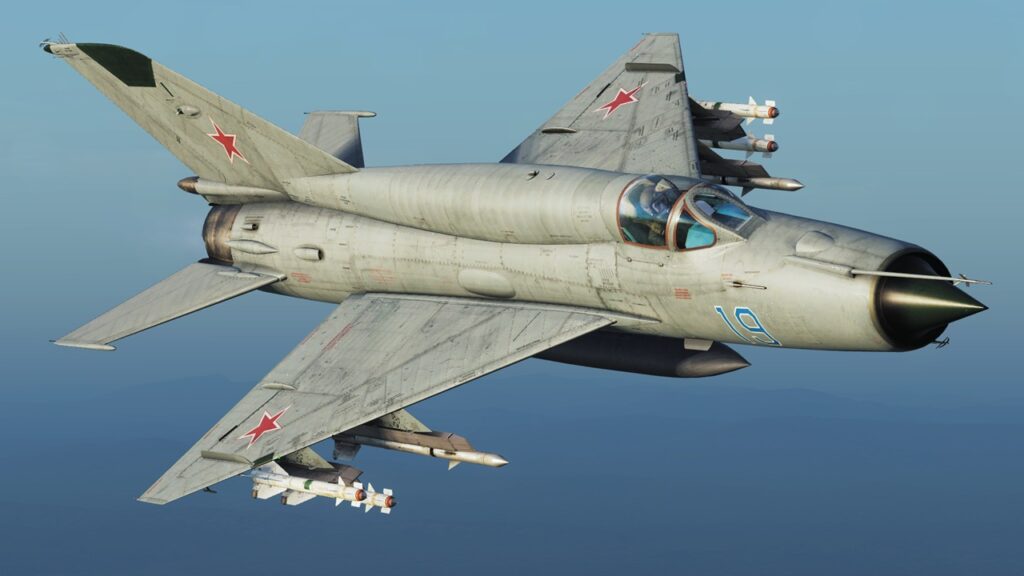
Mikoyan-Gurevich MiG-21
Strengths
- Small visual profile
- Fast acceleration
- Excellent climb
- Dangerous close-range missiles
- High-speed attack capability
Weaknesses
- Poor visibility
- Limited fuel
- Older radar
- Loses energy quickly in sustained manoeuvring
How the MiG-21 Kills F-5 Pilots.
Most kills occur in one of three ways:
1. The Head-On Missile Shot.
Yes, all to often of late. Its easy to focus on what your currently trying to kill like an important high altitude bomber but if your dead you cant help! Turn to face the most dangerous threat. A Mig-21 flying fast will be merging with you very quickly so turn and start killing the Mig-21. You can always come back for the bomber.
The MiG detects you.
You fly directly at him.
He launches.
You realise too late.
You die.
2. The Merge Heater Shot.
This has been such a surprise to me recently having been intercepted while trying to kill valuable bombers on the contention 80s server. The missile launch comes off the rail and seems to be able to turn 80 degrees as we merge. Its impressive to see but its deadly!
You merge.
You cross his nose.
He launches an IR missile.
You never see it.
3. The Vertical Ambush
This is a very common tactic because again Ive been getting killed and never seen them. The RWR (Radar Warning Receiver) is screaming but the MK one eyeball fails to spot it and we all know! Lose Sight – Lose the Fight!
The MiG climbs above you.
You focus elsewhere.
He dives with superior energy.
You are forced defensive.
Surviving the MiG-21
Never Fly Straight At Him
Avoid:
YOU ---------> <--------- MIG
Instead:
YOU  ------->

             MIG
                \
                 \
Offset 20-40 degrees.
Force him to manoeuvre.
Force him to solve geometry.
Crank Early
When contact is established:
- Turn 30-60° off target.
- Maintain visual.
- Preserve energy.
The objective is not to run away.
The objective is to deny a clean shot.
Respect the 2 NM Zone
Inside 2 nautical miles:
Everything happens instantly.
Assume:
- He can shoot.
- He may have already shot.
If crossing the nose:
Cross fast.
Cross unpredictably.
Never linger in front of him.
Beam (F Pole) If You Suspect Launch!
If you believe a missile is airborne:
- Turn hard to place him on the beam.
- Deploy chaff.
- Descend if terrain permits.
- Continue manoeuvring.
Do not simply pull harder.
Make the missile work.
Fighting the MiG-21
Preferred Fight
The F-5 generally wants:
- Sustained turns – 450-500 knots works! Note: Over 450 its easy to snap the wings off!
- Medium speed
- Controlled energy management
The MiG generally wants:
- One fast attack
- One missile opportunity
- One decisive kill
Force him to stay.
Force him to turn.
Force him to bleed energy.
Manoeuvre Kills!
One of the biggest weaknesses of the MiG-21 is its ability to bleed energy during aggressive manoeuvring.
If you can force a MiG-21 pilot to manoeuvre hard in an attempt to gain lead on your aircraft, they can rapidly lose energy and control authority. Over the years I’ve watched many MiG-21s enter departures, spins, and unrecoverable situations simply because they were forced to manoeuvre beyond the aircraft’s limits.
The key for the F-5E pilot is to stay fast.
Maintain your energy and make the MiG work for every degree of lead pursuit. Every hard pull costs the MiG-21 precious airspeed and energy. Its relatively small wings must work harder to generate lift during high-G manoeuvres, and eventually they run out of aerodynamic grip.
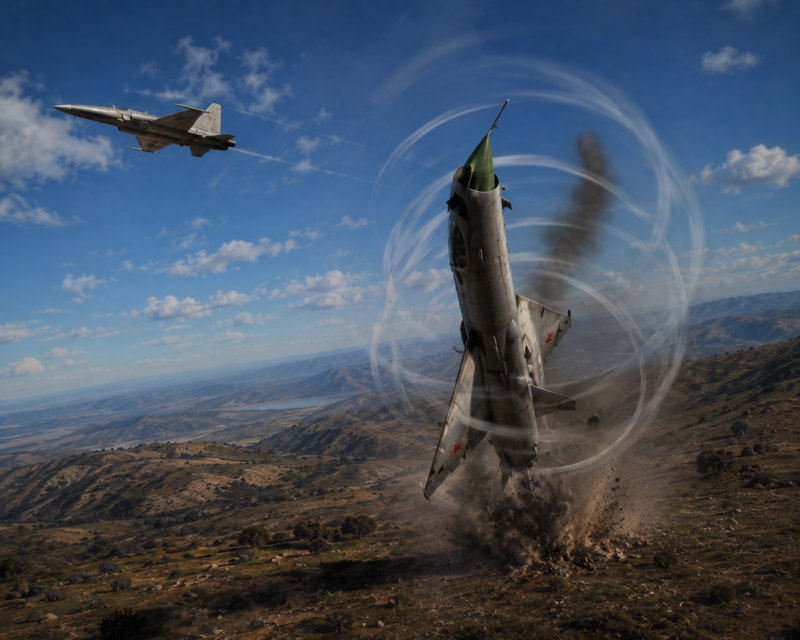
As the MiG slows, its turn performance deteriorates rapidly. The pilot is often tempted to pull even harder in an attempt to keep the guns or missile solution, making the situation even worse.
At low altitude this becomes especially dangerous for the MiG pilot. A loss of control at 20,000 feet may be recoverable. A loss of control at 2,000 feet often is not. Force the MiG-21 to manoeuvre. Stay fast. Stay patient. Let the aircraft make the mistake.
Sometimes the best weapon in your arsenal is simply allowing the bandit to run out of energy before you do.
The Mirage F1 Threat.
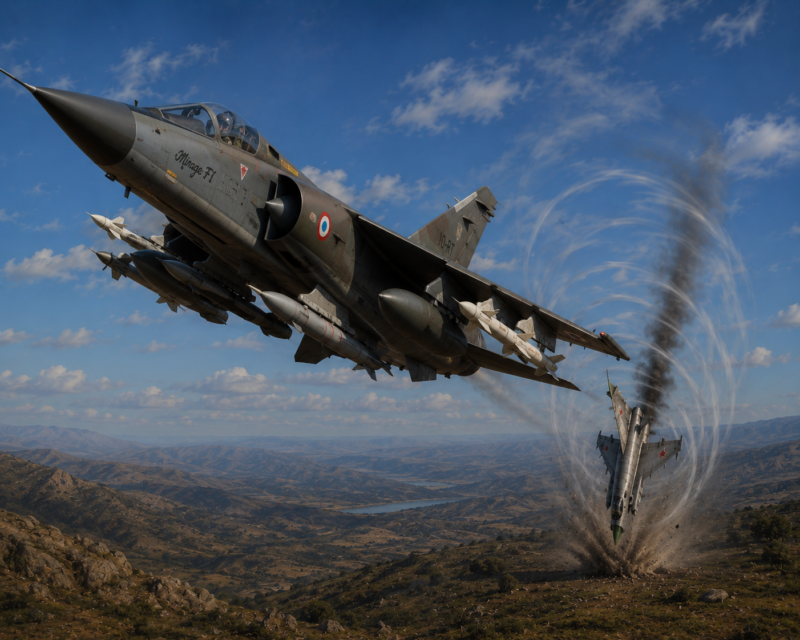
Dassault Mirage F1 is a powerful and fast aircraft that deserves your respect. The F-1 is used as a RED team asset often so be cautious. It Dogfights very well in Cold War scenarios and has both Fox 1 (radar) and Fox 2 (IR) missiles available.
Strengths
- Powerful radar
- Excellent acceleration
- Good energy retention
- Dangerous IR missiles
- Strong boom-and-zoom capability
Weaknesses
- Larger visual signature
- Less comfortable in prolonged turning fights
- Relies heavily on energy advantage
How the Mirage F1 Kills F-5 Pilots.
Most F1 kills happen before the pilot realises danger exists. The F-1 is so fast when you look at the message its 25 Nm away but its doing 600 knots trying to prevent you killing its AWACS or bomber force. Its at your six in no time to react when you see the radar warning indication.
The missile is usually the final step.
The real mistake occurred earlier.
Typical Kill Chain
- F1 spots F-5.
- F1 maintains energy.
- F1 stays unseen.
- F1 enters rear quarter.
- Missile launch.
- End of story. ( To Often! )
Surviving the Mirage F1.
Never Chase Blindly.
One of the oldest traps:
The Mirage runs.
You chase.
The Mirage extends.
The Mirage reverses.
You die.
If the F1 appears to be leaving:
Ask yourself:
Why is he leaving?
Maintain Visual
The greatest Mirage weapon is often not the missile.
It is disappearing.
Once you lose tally:
The Mirage usually gains initiative.
Watch High Six.
Many Mirage pilots:
- Extend
- Climb
- Reposition
- Return with energy
Check behind.
Check above.
Check again.
Fighting the Mirage F1
Force a Turning Engagement.
The F-5 shines when:
- Speed is moderate
- Geometry is controlled
- The fight becomes visual
The Mirage prefers:
- High speed
- Separation
- Repeated attacks
Deny these.
Stay Patient.
Many F-5 pilots die because:
They become offensive too quickly.
The Mirage often wins by baiting aggression.
Patience wins more fights than bravery.
The Most Important Skill.
Tally!
Tally wins fights.
Tally prevents surprises.
Tally defeats missiles before they launch.
When killed, ask:
Not
How did the missile hit me?
Ask:
Where was the bandit 30 seconds earlier?
The answer is usually the lesson.
F-5 Survival Rules.
Rule 1
Never accept a pure head-on merge.
Rule 2
Assume every MiG-21 has a missile available.
Rule 3
Assume every Mirage F1 has already seen you.
Rule 4
Protect your rear quarter at all times.
Rule 5
If you lose visual, regain visual.
Rule 6
Do not chase emotionally.
Rule 7
The missile is rarely the mistake.
The positioning usually is.
Final Thought.
The F-5E is not an aircraft that wins because it is technologically superior. It wins because its pilot sees danger first, avoids bad geometry, manages energy carefully, and forces the enemy into a fight on the F-5’s terms.
On Cold War multiplayer servers, survival is not about defeating missiles.
Survival is about denying the shot in the first place.
“Lose sight, lose the fight.” — a lesson that remains as true in DCS as it was throughout the Cold War.
Author

Brendon McAliece (Aka Gunnie) is a military veteran with 23 years working on Jet Fighters, their weapons systems and ejection seat/module systems as well as munitions and R&D. Involved with flight simulation since the 1980s, he has flown all the major flight simulators over the years.
He is an Australian expat who has lived in Malaysia, UK, Saudi Arabia and more recently Thailand. He is a multi-lingual blogger who loves to share his life experiences here on LetsFlyVFR.com and DreamingGuitar.com, with his lifestyle and Travel experiences Blog plus his Dreaming Coffee website.
Learn More @
DreamingGuitar.com – DreamingCoffee.com – LetsFlyVFR.com
( HOME – BLOG – SHOP – ABOUT )
As an Amazon affiliate I may benefit from qualifying sales.